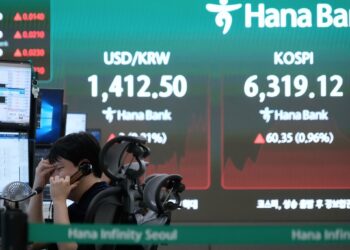

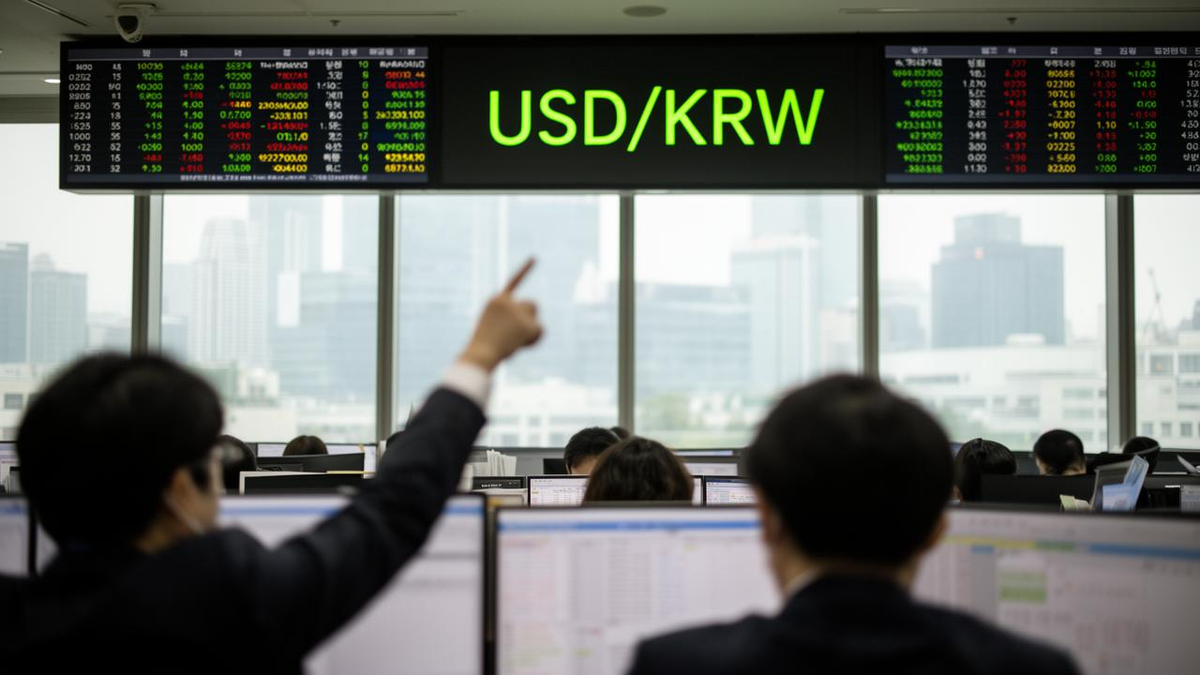
The won-dollar exchange rate rebounded to close higher, supported by bargain hunting despite dollar weakness triggered by a disappointing U.S. employment report.
In Seoul’s foreign exchange market on the 10th, the dollar-won rate’s regular session close stood at 1,418.4 won, up 2.3 won from the previous session. The rate opened at 1,410.3 won, down 5.8 won from the prior session’s close, and fell to as low as 1,407.3 won during intraday trading. However, strong bargain hunting quickly reversed the decline, with the rate rising to 1,419.3 won at one point before settling in the 1,418 won range.
Overnight in global currency markets, the dollar weakened after the U.S. July employment report significantly undershot market expectations. U.S. nonfarm payrolls declined by 23,000 in July, far below the market forecast of an 80,000 increase. Employment gains for May and June were also revised down by a combined 103,000, heightening concerns about a slowdown in the U.S. labor market.
The much weaker-than-expected jobs data also shifted the outlook for Federal Reserve monetary policy. As expectations for a September rate hike receded, U.S. Treasury yields and the dollar fell in tandem. This was expected to sustain risk-on sentiment and dollar weakness across Asian currency markets, exerting downward pressure on the dollar-won rate.
However, the recent sharp and rapid decline in the exchange rate triggered strong bargain buying that offset the impact of dollar weakness. Real demand for dollars, including settlement payments by importers and currency conversions for overseas stock investments, also pushed the rate higher. A rebound in international oil prices further limited the rate’s decline. Lingering concerns over rising oil prices, as negotiations to reopen the Strait of Hormuz face delays, remain a headwind for the Korean won.
The exchange rate has been on a steep downward trajectory since mid-July. The dollar-won rate, which stood at 1,503.4 won on July 13, fell to 1,416.1 won on the 7th of this month. During the session on the 10th, it dipped to 1,407.3 won before rebounding by more than 11 won, suggesting further declines are being capped in the low 1,400 won range.
The won-dollar exchange rate’s volatility this year is the highest since the 2009 global financial crisis. According to the Bank of Korea’s Economic Statistics System, the average monthly fluctuation range this year through the end of last month was 47.0 won, the widest since 2009’s 61.2 won. Historically, average monthly fluctuations exceeding 40 won have only occurred four times: during the Asian financial crisis in 1997 (72.2 won) and 1998 (97.6 won), and during the global financial crisis in 2008 (68.3 won) and 2009 (61.2 won). The average daily fluctuation range this year through the 7th was 8.2 won, also the highest since 2009 (average 9.4 won).
After peaking at 1,555.8 won on the 2nd of last month, the exchange rate fell by 139.7 won over 25 trading days through the 7th — an average daily decline of 5.6 won. The recent downward trend in the won-dollar rate has been driven by dollar selling concentrated among exporters, inflows from SK Hynix’s American Depositary Receipt (ADR) listing, and market intervention by U.S. and Japanese foreign exchange authorities. Notably, the unusual coordinated intervention by U.S. and Japanese authorities, which strengthened East Asian currencies, also played a role.
While easing won weakness helps reduce inflationary pressure and supports foreign exchange market stability, an excessively rapid decline can severely disrupt corporate earnings forecasts and currency risk strategies. Market experts note that recent exchange rate volatility has been amplified by a complex mix of factors beyond traditional interest rate differentials, including geopolitical risks, international oil prices, offshore non-deliverable forward (NDF) trading, and cross-border investment flows.
Foreign exchange specialists view the 1,400 won level as the first support line for the dollar-won rate. Lee Min-hyuk, an economist at KB Kookmin Bank, said, “The 1,400 won level is expected to serve as the first support line, and if the Fed holds rates steady and international oil prices stabilize, the rate could settle in the 1,300 won range.” However, he cautioned that “if increased stock market volatility triggers outflows of overseas equity investment funds and foreign investor capital, or if the yen weakens again as the effect of U.S.-Japan foreign exchange coordination fades, the won could also resume its weakening trend.”
Lee added, “The dollar-won rate has declined for six consecutive weeks, entering technically oversold territory,” and noted, “This week, we lean toward the possibility that the pace of decline will slow somewhat.” He further explained, “With Fed Chair Kevin Warsh’s remarks keeping September rate hike concerns alive, and if this week’s U.S. inflation data comes in higher than expected, some dollar-won short covering could emerge. Amid continued onshore dollar supply, we anticipate a ‘stair-step decline’ where bargain buying supports the downside.”