

South Africa’s cryptocurrency regulatory framework is entering a new phase with recent court rulings and proposed rules giving authorities greater powers to scrutinise crypto transactions, particularly those involving the movement of capital offshore.
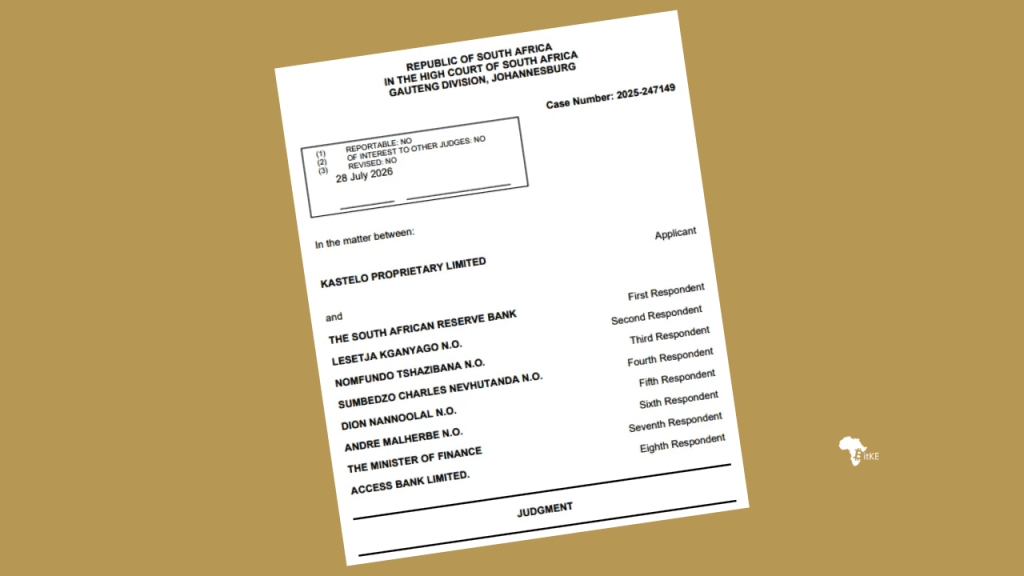
The latest development came on July 28 2026 when the Gauteng Division of the High Court in Johannesburg dismissed an application by fintech company, Kastelo, to overturn a South African Reserve Bank (SARB) blocking order on its bank account.

The court found that SARB had reasonable grounds to suspect that Kastelo’s business model contravened South Africa’s exchange-control regulations and held that the central bank was not required to prove an actual contravention before issuing a blocking order.
The case involved Kastelo’s algorithmic crypto-trading model under which clients used their foreign-exchange allowances to facilitate transactions involving foreign currency and crypto assets. SARB alleged that the structure circumvented exchange-control restrictions and that about R4 billion (~$250 million) had been transferred offshore during 2025.

The court accepted SARB’s evidence that there were reasonable grounds for suspicion and upheld the blocking order.
The judgment is significant for crypto businesses because it confirms that existing exchange-control enforcement powers can be applied to crypto-related business models where authorities believe there is a risk of regulatory circumvention.

It does not, however, establish that crypto transactions are inherently unlawful or that every offshore crypto transfer constitutes an exchange-control violation. It is a High Court ruling and does not finally resolve the broader legal question of how crypto assets should be classified under South Africa’s exchange-control regime.
That question has already produced conflicting judgments.
In June 2026, the Johannesburg High Court ruled in Mangundhla & Another v South African Reserve Bank that Bitcoin is both ‘money’ and ‘capital’ for purposes of the Exchange Control Regulations. The court expressly rejected the approach taken in the 2025 Standard Bank v SARB case in which another Gauteng High Court had concluded that cryptocurrency was neither money nor capital for exchange-control purposes.
The result is a significant shift, but not yet a final judicial settlement.
The broader regulatory direction is nevertheless becoming clearer.
South Africa began developing a formal crypto framework through the Intergovernmental Fintech Working Group (IFWG) after years of treating digital assets primarily as an emerging financial risk. In October 2022, the FSCA declared crypto assets financial products under the FAIS Act bringing crypto-related financial services into the licensing regime.
South Africa’s Financial Regulator, FSCA, Declares Crypto Assets as a Financial Product
The CASP licensing framework took effect in June 2023. By March 2026, the FSCA had received 533 applications, approved 310 and declined 17, with additional applications withdrawn or still under consideration.
2025 RECAP | South Africa Had Approved 300 Crypto Firms Out of 512 Applications as of December 2025
Regulation has since expanded beyond licensing.
South Africa implemented the OECD’s Crypto-Asset Reporting Framework in March 2026, requiring qualifying crypto-asset service providers to report transaction information to SARS.
TAXATION | The South African Revenue Service Publishes New Crypto Reporting Rules
At the same time, Treasury and SARB have been working to bring crypto assets explicitly into the country’s capital-flow framework. Draft Capital Flow Management Regulations, 2026, published in April 2026, proposed replacing the existing Exchange Control Regulations and expressly incorporating crypto assets.
In August 2026, Treasury and SARB released a draft Crypto Assets Manual dealing specifically with cross-border crypto transactions, including permissions, reporting, and the role of authorised crypto-asset service providers.
This puts the Kastelo and Mangundhla judgments into a broader context.
South Africa is no longer simply asking whether crypto should be regulated. It is increasingly deciding how crypto should fit into existing financial, tax, AML and exchange-control systems.
For the industry, the emerging principle is important:
Regulators and courts are increasingly looking at what crypto assets do economically
- transferring value,
- holding capital, and
- moving funds across borders,
See also

rather than relying solely on whether they resemble traditional currency or financial instruments.
The immediate consequence is greater regulatory risk for businesses whose crypto models involve offshore flows, foreign-exchange allowances, or structures that could be viewed as circumventing capital controls.
The longer-term question will be whether the Supreme Court of Appeal ultimately resolves the conflicting High Court interpretations over whether Bitcoin constitutes capital under the existing exchange-control regime.
Until then, Kastelo provides another important signal:
Crypto may be digital and decentralised, but South African regulators increasingly intend to treat the economic activity around it as subject to the country’s financial-control architecture.
Stay tuned to BitKE for updates into crypto regulation in Africa.
Join our WhatsApp channel here.
Follow us on X for the latest posts and updates
Related
![Samsung Electronics and SK hynix’s Unprecedented Shareholder Returns… Even the Exchange Rate Is Shaken [Weekend Money]](https://www.currency.coach/wp-content/uploads/2026/08/2026082017042687374_1787213066-350x250.png)