

The U.S. Federal Reserve’s decision to raise interest rates has presented Vietnam’s monetary policymakers with a tougher balancing act: keeping financial conditions supportive enough to underpin growth while maintaining exchange-rate stability and containing inflation.
The Fed’s 25-basis-point rate hike, which took the federal funds rate to 3.75-4%, has added another variable to Vietnam’s monetary policy outlook.
More significant than the size of the increase is the signal that the Fed could keep interest rates elevated. Meanwhile, domestic inflation is approaching the government’s target. Average consumer prices rose 4.45% in the first eight months of the year, while core inflation increased 4.24%.
Against this backdrop, further cuts in dong interest rates to support growth will become more difficult, although Vietnam does not yet face an immediate need to raise its policy rates.

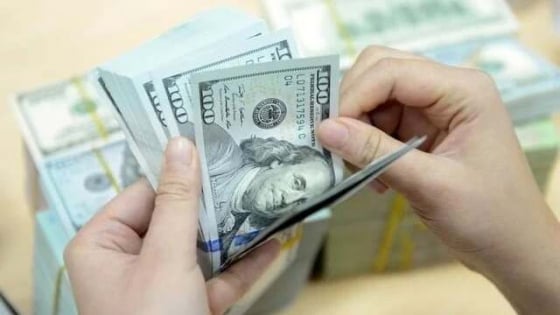
A clerk counts U.S. dollar banknotes. Photo courtesy of Thanh Nien (Young People) newspaper.
Fed hawkishness puts more pressure on the dong
According to BIDV bank’s chief economist Can Van Luc and his research team, the Fed’s decision could alter expectations for interest rates, exchange rates, capital flows and global funding costs, affecting highly open economies such as Vietnam.
However, the team said the latest rate hike would not put excessive pressure on the USD/VND exchange rate. One key factor is that the interest-rate differential between the dong and the U.S. dollar remains positive at about 0.5 percentage points on average.
Domestic foreign-exchange supply is also supported by foreign direct investment, remittances, tourism receipts and other capital inflows.
Luc and BIDV’s research team forecast the USD/VND exchange rate could rise by only 0-0.5% in 2026 from the end of 2025, followed by an expected increase of about 1-2% in 2027 if the Fed keeps rates high.
The issue, therefore, is not an immediate exchange-rate shock following the Fed’s decision, but the potential accumulation of pressure if the United States maintains tight monetary policy for longer than expected.
In fact, the central exchange rate has repeatedly hit record highs ahead of the Fed meeting. On September 15, the State Bank of Vietnam (SBV) raised the central rate to 25,617 dong per dollar, above its previous high. By September 20, it had risen to 25,637 dong, an increase of about 40 dong in just one week.
The moves show that exchange-rate pressure has emerged, although it has not yet translated into sharp volatility in the foreign-exchange market.
Nguyen Quang Huy, head of the finance and banking faculty at Nguyen Trai University, said the impact of the Fed extends beyond the exchange rate to foreign-currency borrowing costs, international capital flows, trade and imported commodity prices.
This is particularly relevant as Vietnam’s imports are rising rapidly. Import turnover reached about $395.3 billion in the first eight months, up 35.3% from a year earlier, with capital goods accounting for 94.1%.
A stronger dollar can raise the dong cost of imports even if international commodity prices remain relatively stable, Huy said.
Inflation becomes a constraint on dong rates
If the exchange rate represents an external source of pressure, inflation is the factor that makes it harder for the SBV to ease monetary policy more aggressively.
Consumer prices rose 4.89% year-on-year in August. In the first eight months, CPI increased 4.45%, while core inflation rose 4.24%.
Average CPI growth is now close to the government’s inflation-control target of about 4.5% for 2026, making the interest-rate equation more complicated.
Under normal conditions, when the economy needs strong growth and credit is expanding rapidly, cutting interest rates would be one way to support demand for capital.
But when the Fed raises rates and the dollar tends to strengthen, cutting dong rates too quickly could narrow the interest-rate differential between the dong and the dollar, putting additional pressure on the exchange rate.
A weaker dong, in turn, can feed into inflation through higher import prices, particularly for energy, raw materials and machinery.
If global oil prices remain elevated because of geopolitical tensions, the impact could become more pronounced. Higher energy costs would affect not only CPI directly but also transportation, logistics and production costs.
Luc said the Fed’s rate hike increased the risk of “imported inflation” and narrowed the scope for domestic rate cuts..
Some economists have also highlighted the need to view interest rates in conjunction with exchange rates and foreign-currency risks. For companies that borrow in dollars but generate most of their revenue in dong, a stronger dollar combined with higher global interest rates would increase financing costs and debt-servicing obligations.
If the Fed continues raising rates or keeps them high for an extended period, pressure could therefore extend beyond the foreign-exchange market to the banking system and corporate sector.
However, a key point in current analyses is that Vietnam does not necessarily need to raise its policy rates simply because the Fed has done so.
Economists say the SBV’s response will depend on three main factors: exchange-rate movements, system liquidity and domestic inflationary pressures.
If the exchange rate remains under control, foreign-exchange supply remains favorable and expectations of dong depreciation do not rise sharply, the SBV could continue using market-based tools to manage conditions rather than immediately raising policy rates.
Developments following the Fed’s decision suggest this approach is already becoming evident.
During the week of Septeember 14-18, the SBV withdrew more than VND62.5 trillion ($2.4 billion) through open-market operations.
Meanwhile, the overnight dong interbank rate rose to 4.5% at the end of the week, up 1.2 percentage points from the previous week, while the two-week rate reached 6%.
The moves suggest the SBV can use liquidity management and market instruments to influence short-term interest rates rather than necessarily changing policy rates.
Suan Teck Kin, head of global markets and economics research at UOB, said the SBV could keep its policy rates unchanged for the remainder of 2026 and into 2027, despite significant pressure from interest-rate differentials and the exchange rate.
That means a more likely scenario may not be a sharp increase in policy rates, but pockets of upward pressure on dong market rates, particularly at shorter maturities and in the deposit market.
SBV: Faster growth must go hand in hand with macroeconomic stability
The SBV’s latest comments suggest it is not seeking to respond to the Fed on a one-for-one basis, but is instead focused on maintaining stability in the economy’s key balances.
Speaking at Techcombank’s 2026 Investment Conference on September 19, SBV Deputy Governor Nguyen Ngoc Canh said the central bank would continue to conduct monetary policy proactively and flexibly, while closely coordinating with fiscal policy and other macroeconomic policies to control inflation, contribute to macroeconomic stability, and support sustainable economic growth.
This means the scope for monetary-policy action will depend heavily on actual developments in the exchange rate, inflation, liquidity and demand for capital.
If exchange-rate pressure increases while inflation remains under control, the SBV could prioritize liquidity and market-management tools. Conversely, if inflation and exchange-rate expectations rise simultaneously, there would be less room to maintain low interest rates.
Canh stressed that rapid growth must go hand in hand with macroeconomic stability; large-scale capital mobilization must be accompanied by market discipline; and innovation must go hand in hand with risk management. Credit provision must also be linked to system safety, credit quality, and the substantive economic and social efficiency of projects, he said.
The approach is particularly relevant as Vietnam targets high economic growth and strong credit demand. With international funding costs tending higher, simply expanding credit to meet growth targets could increase pressure on banking-system liquidity, interest rates, the exchange rate, and asset quality.
The monetary-policy challenge, therefore, is not only how much additional capital to provide, but also where that capital goes and how effectively it is used.
The deputy governor also said Vietnam needed a more balanced development between the money market and capital market, expanding medium- and long-term funding channels for businesses.
A multi-layered, transparent and efficient financial ecosystem would help ease maturity pressures on the banking system and strengthen the economy’s resilience to external shocks, he said.
The SBV’s stance points to a relatively clear policy approach: it will not necessarily follow every Fed rate increase, but neither will it sacrifice exchange-rate and inflation stability to maintain low interest rates at all costs.