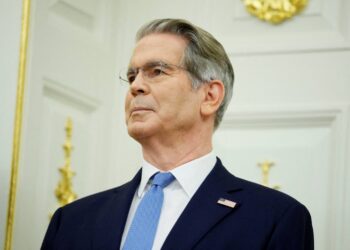

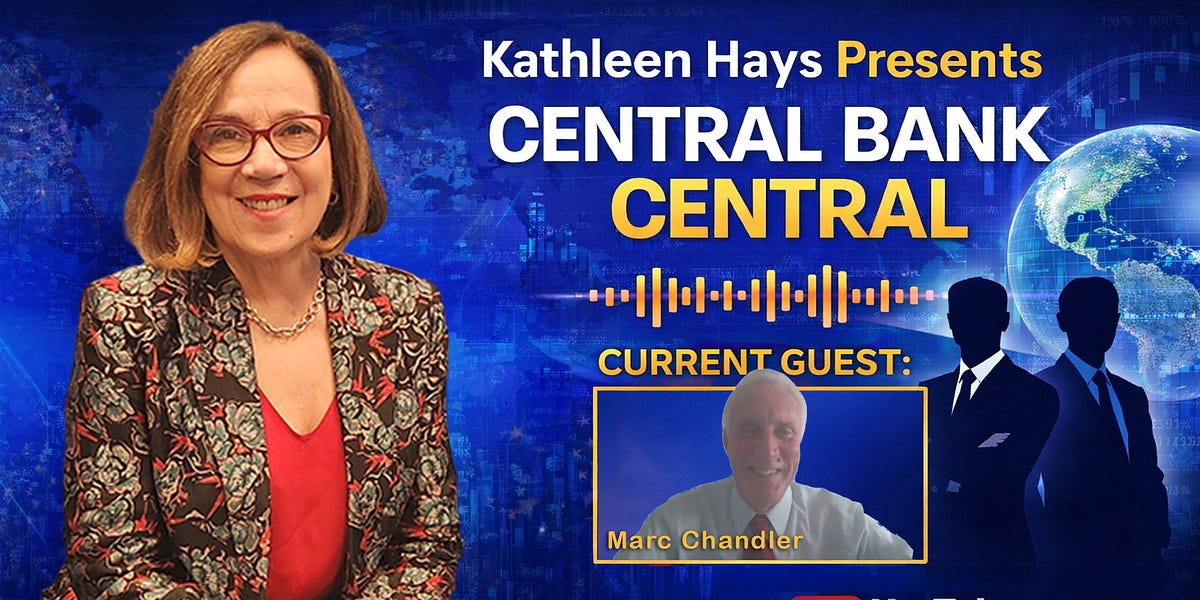
Marc Chandler, the chief market strategist and managing director at Bannockburn Capital Markets, has been covering the currency markets for more than 25 years at some of the largest banks and custodians in the world. Now, as the groundbreaking end of the Bretton Woods Agreement is hitting more than half a century, Marc is zeroing in on what this has meant for global currency markets back then and where he sees the dollar heading next.
As he wrote in a recent piece, “Fifty-five years ago today, Nixon closed the gold window. The move was billed as temporary. It became permanent and launched the dollar into a half-centruy of dominance nobody in 1971 would have predicted. Now, on the anniversary, the cracks in that architecture are getting bigger than ever.”
Looking back to the start of the Bretton Woods agreement. Marc emphasizes that it was not merely an economic arrangement but a reflection of post-war power structures.
“Ultimately the issue was about power and politics. The U.S. was emerging from the war, as the dominant power, and as a creditor nation, they wanted to shape the rules of the game that benefited it,” he noted. “So the rules were the game, it was sort of like one of those golden rules, right? He with the gold makes the rules.”
He is skeptical of returning to a gold standard or fixed exchange rates, arguing that the political and economic conditions that enabled Bretton Woods no longer exist.
“The idea of Bretton Woods was successful only because there was this unipolar moment. The multipolar is going to make an agreement that suits both the creditors and the debtors. It’s just not possible. Not politically realistic.”
Marc links renewed interest in gold among central banks to geopolitical events that he says have undermined trust in dollar and euro reserves. “Gold…has captured people’s imaginations again. And I think partly you see this in central bank activity after the US and Europe froze Russian reserve assets and this made dollars and euros, foreign currencies, less trustful, less trustworthy.” But he remains skeptical that this signals a return to a gold-based system, viewing it instead as a hedge against uncertainty.
He also sees the depth and liquidity of U.S. capital markets as supporting the dollar’s central role.
“The U.S., the depth and breadth of the its capital markets, allows the U.S. to absorb the world savings, even though there’s, on one hand, the central banks that have reduced their dollar holdings as a percentage of reserves because the US runs a large current account deficit… foreigners have little choice but to acquire US assets.”
Marc does see the dollar’s dominance continuing as the post-Bretton Woods world continues to evolve. “Dollar, yen, euros – we’re not backed by gold or silver any more. They’re determined by our willingness to accept them. And I think that it’s really ultimately a question of trust and a question of power.”
”I think that President Trump, on his own, can I say ‘peculiar way,’ represents the first effort by the U.S. political elite in a century to recognize that it’s no longer the hegemonic power, it’s no longer the top dog unchallengeable country in the world.”
“I think we’re moving to a more multipolar world. I think the currency market is going to reflect that more fragmented
This interview gave me a chance to walk down memory lane with Marc, to revisit the history of Bretton Woods and to remember why it failed and why it was destined to fail. The global economy is changing and few are really ‘fans’ of the current exchange rate system, but there is nothing else that is suitable; for all its flaws, here it is.
The system is prone to become mis-aligned, as Marc notes, as we also discuss major currency-driving events like the Plaza Accord, the Louvre Accord, the Asian financial crisis and, more recently, the joint US-Japan support project for the yen are evidence of the need for occasional propping up of the sytem.
The cracks in the system are evident and pressures remain intense. Global fiscal debt loads have largely increased, reducing systemic flexibility. Marc reminds us that global systems are also about power and power relations that are shifting. Wondering about the impact of gold prices soaring, and the precious metal being accumulated again? Dive in. He covers all this and more in a way that only this foreign exchange maven can.
Remembering Bretton Woods 00:01:33:22 –
Yeah…it’s a fairly a fascinating history. Bretton Woods was an agreement towards the end of World War two. 1944 many countries met in New Hampshire, and there was for the US, we had our Harry Dexter White was negotiating for the US. And on the UK side, negotiating on the other side was John Maynard Keynes. So it was quite like these super strong personalities.
Historic figures negotiating 00:02:00:08
These like really historic figures negotiated Bretton Woods. And the ultimate agreement that came out was that the dollar would be pegged to gold at $35 an ounce. You know, today we’re trading close to $4,400 an ounce. So gold was the dollar was pegged to gold at $35 an ounce, and everybody else’s currencies were pegged to the dollar. They were allowed to move in a very small range, about 1%.
Near the end of WWII 00:02:27:23
At that meeting, it also established the world Bank and the IMF. And so that was like the we were close enough to the end of the war. It was still a year or so before the US used the atom bomb on Japan, and that the so the US knew the war was coming to an end…
A recognized need for new mechanics or plumbing 00:02:50:20
And those pre-war conditions
But at its core the meeting was a power play 00:03:17:22
But ultimately the issue was about power and politics. The US was emerging from the war, as the dominant power, and as a creditor nation, it wanted to shape the rules of the game that benefited it. So the rules were the game was sort of like one of those golden rules, right? He with the gold makes the rules. The US had the gold that shaped the financial infrastructure, financial superstructure that benefited the world’s largest creditor nation.
Floating exchange rates were not a sought-after solution 00:04:10:18
I think that, you know, up until then that was all of our experience. We knew that the floating exchange rates that were sort of like existed between the wars was sort of an anomaly. It wasn’t stable. It led to beggar thy neighbor types of policies. So floating exchange rates were not really even a question. This was really like anathema to everybody, whether you’re a creditor or a debtor.
A dollar centric system was not the only choice 00:04:34:04
The issue really was whether it should be the dollar should be the key reserve currency, which is what of course, the US wanted. Or should there be some kind of international currency created? And that’s what Keynes argued for is called the Bancor Banker. And it’s not such, even though it seems like a long time for us that a few years ago, when Mark Carney was at the Bank of England, he came over and spoke in the US, and he wanted to resurrect the idea of a banker and electronic form of it.
Interests are now balanced 00:05:07:13
And again, and I think this is why we don’t have another Bretton Woods ultimately, is that the we don’t have this unipolar moment right now. If anything, it’s multipolar and you can’t have I mean that the idea of Britain was was successful only because there was this unipolar moment. The multipolar is going to make an agreement that suits both the creditors and the debtors. It’s just not possible. Not politically realistic.
Bretton Woods collapsed because… 00:05:44:03
Yeah, I think that the conventional reason is because the US, between the war in Vietnam and the war on poverty at home, the Great Society that the US was becoming a debtor, its creditors status was eroding foreigners. And this wasn’t at the time about Russia, the Soviet Union or China. This was about mostly European countries. They wanted more gold for their dollars than the US was willing to part with.
Nixon …No Mas! 00:06:11:00
So in that fateful day on August 15th, 1971, Nixon unilaterally closed the gold window, said there were no longer going to swap dollars for gold and for these foreign central banks, decoupling the dollar from gold and ushering in this era of floating, which I think really is a euphemism for volatile exchange rates.
A new system?? 00:07:05:14
You know, it’s just not clear what it would look like. But it does seem that foreign central banks have been accumulating a lot of gold. And again, it’s not just about China. Poland, for example, has been acquiring a lot of gold. I think last year they acquired more gold than China did. And you know what else did another big buyer of gold recently is not even these foreign central banks.
Gold acquired by central banks and a stable coin issuer 00:07:26:00
Tether, who has a stablecoin backed by gold. They have a lot of gold, just like they have a dollar backed stablecoins. They have a lot of treasuries. So gold has I think that gold had become captured people’s imaginations again. And I think partly you see this in central bank activity after the US shows the US Europe froze Russian reserve assets and this made dollars and euros, foreign currencies, less trustful, less trustworthy.
Some central banks are still accumulating gold 00:07:56:21
And so we have seen foreign central banks buy gold. And in some surveys they’ve indicated that the central banks anticipate buying more gold.
The Plaza accord 00:08:22:14
Yeah, I think that, you know, back in 1985, there was an attempt to drive the dollar down. We called it the Plaza agreement. And there was a there was some thoughts around the time that maybe we could engineer trading ranges rather than fixed exchange rates. Maybe we defend ranges sort of like the European exchange rate mechanism did wider ranges, and at both the weak currency and the strong currency country would have to defend it.
Discipline! Order! Sounds good- but who wants it? 00:08:47:22
But I think it’s something like this. The gold standard forced a discipline on countries like spending fiscal policy and nobody people want people talk wistfully of putting that discipline back on, but nobody really wants to do it themselves.
Oil backs the dollar and vice versa 00:09:39:11 –
I think there’s an idea that sometime in the 60s, the Saudis agreed with the US to only price oil in dollars and linking them to price of oil and OPEC to the dollar. And some countries like Saudi Arabia have pegged their currency of the dollar. However, you know, I’ve been trying to analyze the currency markets for a long time.
The FX churn is mind boggling 00:10:03:09
And what I have found is that that the capital market, just the currency market alone, for example, the average daily turnover is about $9.6 trillion. It’s humongous $9.6 trillion means within a week in the foreign exchange market, has enough turnover to cover a year’s worth of trade of goods and services. So I think about what drives the currency market.
Churn is not driven by trade 00:10:28:23
Ultimately, I don’t think it’s really the trade in goods. I think it’s what moves capital. And I think this is where the dollar US asset markets have are. So like this is where American exceptionalism lies. I think that the US, the depth and breadth of the US capital markets allows the U.S. to absorb the world savings, even though there’s on one hand, the central banks have reduced their dollar holdings as part of a percentage of reserves because the US runs a large current account deficit, a large trade deficit which includes not only trade and services but some capital flow
The accountants treadmill 00:11:06:01
Because the US such a deficit, foreigners have little choice but to acquire US assets US stocks, bonds, factories. And so I think that for me, what this means then is that this idea that sometimes people have of sell America, it just doesn’t like hold water because we want a deficit, chronic deficit. Foreigners are acquiring our assets and right now they’re buying US stocks.
An era of stock preferences 00:11:30:12
They prefer US stocks over treasuries. This is this is funding the US current account deficit and is helping the lift US equity prices to higher levels. In fact, just today we made new highs in the S&P 500 new record highs. So I think this is sort of where we are is where the dollar is maybe less trusted from official sector.But foreign private sector investors are big buyers of U.S. stocks.
BIS estimates 00:12:10:02
So yeah. So you look at the BIS figures, that’s where this comes from. The Bank for International Settlements, they try to avoid a lot of that double counting, but it probably is still some there. But it’s just to recognize just the huge volumes that are going through. So and I think to your point, you know, a bank gets some client, large multinational company or a hedge fund, why don’t they buy $100 million? They might not do it all at once. They might have $10 million and they sell it to Citibank, and Citibank sells it to speak, and HSBC sells it to Deutsche Bank. So it goes around. And so you’re right that there’s some like a like an echo effect. But
An era of openness and cooperation 00:14:02:15
This is where the high watermark of international cooperation, like the G7, G5 coordination, what was happening was that I think sort of the general narrative would be something like this. The policy mix the US had that is tight monetary policy under Paul Volcker. We’re talking about the early 1980s and relatively expansionary fiscal policy by President Reagan at the time. I know we have an image of him as being very conservative, but he was cutting taxes, increasing different types of spending. So fiscal stimulus, monetary policy tightening, and the dollar shot up not only against at the time, of course is it before the euro. This is like the Deutsche Mark, the Japanese yen, the Swiss franc. And so it took a while.
Not tariffs but new constraints 00:14:44:05
But these low, these weakness of these other currencies was fueling inflation at home. And it was fueling protectionism in the US. I don’t remember this guy, Louis Gephardt from Missouri, a representative who was taking sledgehammer to Japanese car imports at the time, part of a campaign kind of thing. So protectionism rising in the US. And I know the you know, we realize now that President Reagan wasn’t a big fan of tariffs, but different types of protectionism at the time. Voluntary export restrictions. Then of course, voluntary is in quotation marks and orderly and market agreements and textiles. There were these types of protectionism ultimately end up to undermine the gap. The general agreement to talk and talk. Right. The general agreement on trade and tariffs (GATT) that gets replaced by the WTO. So we reached this crescendo where the US didn’t want the dollar to get much stronger.
Dollar transitions from strengthening to weakening 00:15:37:09
Europe and Japan didn’t want to have their currency to get weaker. They jointly agreed to intervene in the foreign exchange market. And by intervening, I mean they were selling dollars. And at the time it seemed like a large amount of dollars. And it was a big reversal. And so this led to a roughly a ten year decline in the dollar.
Post Plaza…00:15:55:11
Now, you mentioned after the plaza, there’s another agreement that the Europeans especially wanted. They thought their currents that fallen far enough, and they wanted agreement to call off the plaza agreement, if you will. And, and but the US wasn’t really fully supportive of that thought that the dollar needed to correct much more. And so but sometime after that, it wasn’t really until around the mid 90s that we get Robert Rubin into the Treasury and Robert Rubin says a strong dollars in U.S. interest.
Many facets of a ‘strong dollar’ policy 00:16:24:11 –
And by that, I think he meant the U.S. with those which would not seek to weaken the dollar purposely to to reduce our debt burden. There’s really a signal to creditors at the time who owns so many U.S. treasuries. But that also ushered in this era that we live in now for the for the most part, where I say that the markets determine exchange rates occasionally within the agreement, the G7 agreement is like an opt out clause.
FX intervention has since become a rare event– 00:16:49:12
It says, well, if you’re in a very volatile situation, you could you can’t intervene. And that is essentially what’s happened recently, both in April and May of this year when the Bank of Japan intervened heavily. They and they also recently intervened in late July with the federal with the US Treasury, I should say, joining them. So intervention now is very rare.
Plaza & Louvre here high water marks for intervention 00:17:11:00
Plaza and Louvre with a high watermark to the intervention. It comes about with floating exchange rates get to extreme levels in the post Bretton Woods era of floating exchange rates.
Yen reached ‘nostalgic’ levels 00:18:41:00
Yeah, I think of this challenge that is happening is really a short term phenomenon. That is when, you know, even though the dollar reached 40 year highs against the Japanese yen, the yen was only up about 3 or 4% this year. It wasn’t a big move. It was just that it was like by like levels that we haven’t seen, I mean, since early. I mean, I’m sorry to say this, but early in my career.
FX, Japan, and why… 00:19:04:22
And so I think that the intervention was a bit different than usual and a couple of different reasons. On one hand, I think you’re right what the Japanese did was very much like textbook Japanese. And by that I mean, when the Japanese intervened, the foreign exchange market or when they when they did QE and expanded their balance sheet, they try to overwhelm the market in size record interventions like that, that intervention at the end of, at the end of July seem to be about $80 billion.
Bessent’s oops..or was it? 00:19:36:02
And remember those? I think it was a Reuters reporter who said it had a picture of a note supposedly accidentally left on Besson’s desk to do list that said by like, I think it was like 5 or 10 or 10 or $15 billion, $1 billion worth of yen. I think it was a sort of a bit sophomore type of ploy.
Big foot Vs the artful dodger 00:19:55:00
But the idea is that while the Bank of Japan and the Japanese tend to try to overwhelm the market in size, the US uses finesse small amounts, well-timed, more market savvy. And it’s not just that Bessent came from a hedge fund, but we’ve seen this with other Treasury secretaries picking their time, catching the market off guard. But I think what also caught the market off guard this time with the US did was in the past, the US has when in a case like this, the US would sell dollars and by Japanese yen, but this time it did it, it sold euros.
U.S. sold Euros Vs Yen? 00:20:30:14 –
And that’s important because it should have raised the question, well, why didn’t they sell dollars? And I think the answer, we don’t know because they haven’t said anything. But I think the reason that many of us have speculated about is that they did not want to be seen, that the US Treasury didn’t want to be seen selling US dollars as U.S. treasuries to liquidate, to sell those dollars in the foreign exchange market.
Is the US Treasury walking on egg-shells? 00:20:51:16
And that raises questions about how secure are they in the Treasury market, how how solid of a footing is its deepest liquid bond market in the world. It’s such a benchmark. So it raises some concerns on that side. But the other thing that’s unusual about this intervention, I thought, was that typically when the Treasury intervenes, the Federal Reserve intervenes as well, not just as an agent for the Treasury, but with their own money.
An intervention in Euros the Fed did not join in 00:21:17:17
It doesn’t look like that was the case this time, that the Treasury, in effect, acted on its own. It didn’t tell Europe it was selling euros. It didn’t. It used the Federal Reserve as an agent, but didn’t get the Federal Reserve to pony up its own money, which could have been a bigger splash if it wanted to. And maybe one last point I’d make about it is we talk about what officials have done. I sometimes think about including for myself what I haven’t done, and I think about what best it didn’t do. And back in April and May, when the BOJ had record intervention, where was the US? It didn’t say a word. It didn’t do anything back in January. Best thing, they tried the same ploy that he did this time. Not too much intervention but something like this. You know the Federal Reserve calls her out and talks to banks. In my experience with on a daily basis, see where the markets are. Talk about prices. It’s not revealing policy. It’s really just checking in. Where’s the dollar right now? Kind of a question. And when they do it people know who they’re talking to that this is the Federal Reserve operation.
Intervention wrobith an explanation 00:22:19:03
But in January and again at the end of July, when the Federal Reserve called around, they made it clear that they were doing it on behalf of the US Treasury. And so I put this up as a if intervention is a big escalation ladder. They climbed a little bit on it by having this type of verbal intervention.
Japan policy is making the yen weak…00:23:41:02
I think a lot of people think that the yen is weak because of Japanese policy. I’m not as persuaded part, of course, as Japanese policy. It’s among the I mean, at 1% their overnight interest rate, it’s it’s extremely low. But here’s what I would say in Japan’s defense. One is that almost all Asian currencies are down this year except the Chinese currency.
Asian currencies are from low yielding asset bases 00:24:02:06
And what do all these Asian currencies have in common? They all typically have low interest rates. If you are to invest in you want high yields. You go to Mexico, Brazil, Colombia, Hungary, Turkey, South Africa, further out on the risk profile. And so one popular trade among hedge funds and leveraged participants has been to sell the Asian currencies by Latam currencies.
Yen responds most to US ten-year yields 00:24:25:22
So what is Japan’s partly caught up in this. But secondly, I sort of think that you know that. So I try to like test ideas, test my ideas, treat them like hypotheses and what I find right now. And after I did this 100 day correlation, how much are changes in in the dollar against the yen correlated with changes in Japanese interest rates? Ideally, we’d like to see higher Japanese interest rates mean a weaker dollar stronger yen. It’s not the case. The best, the most. I want to say that the interest rate that the exchange rate is most sensitive to is the US ten year yield. And so they are combined. And why would that be? And I think it’s because Japan doesn’t have a trade surplus anymore.
Japab Still investing 00:25:11:14
They’ve got a trade deficit but they’ve got a current account surplus, this other capital from the past investments. So that’s yield payments. It’s profits. It’s royalties, licensing fees, all those kind of return-on-capital flows. That’s why Japan has its current account surplus. So what do they do with that surplus. They don’t keep it at home. They buy foreign bonds and foreign stocks.
U.S. economy is strong and still deficit financing 00:25:36:12
And so my guess is that the reason that the dollar yen is so sensitive not to Japanese interest rates, but to US interest rates has to do with Japanese capital flows. And when it comes to the budget deficit, you know, I’m partly surprised in the sense that here the US has while the economy is growing well above trend, it has something on the magnitude of 5% budget deficit.
Japan: smaller deficit but massive debt ( I-Owe-Me’s) 00:26:00:07
Japan’s is less than 3%. But I think to your point, what bothers a lot of people, it’s not so much their deficit, but their debt, their debt. Like I say, Japan tends to try to overwhelm the market. Their debt to GDP, just in gross terms, is over 200%. And I say gross terms because who owns a lot of JGB? Of course, are Japanese themselves. Foreigners own a relatively small part of JBS, maybe five to say 7% or so. So a lot of those JGB are held domestically. And so that’s part of the challenge. And you know, the other part of the JGB that are owned by the private sector in Japan, over half of them are owned by the Bank of Japan itself, which to your earlier point the they’re slowly divesting themselves of.
Equities too: BOJ cast a wide net – 00:26:46:00
Same thing with equities. You know, the Federal Reserve never bought stocks during its QE operations. And I want to say the Japanese bought almost everything but my comic book collection. They weren’t buying corporate bonds. They were buying high yielding euphemism for junk bonds. They bought equity ETFs. So they have big owner of Japanese stocks and Japanese bonds.
FX is an open rough and tumble arena 00:27:20:21
Yeah I think I spent a lot of time thinking about that, usually with a beer. But I suspect that we are moving. I think that the currency system, and this is one of the reasons why I elected and really enjoyed myself following the foreign exchange, because I think there’s something… I mean, it’s sort of like my crypto friends are right.
A new game in town with more parity 00:27:41:02
Dollar, yen, euros. We’re not backed by gold or silver anymore. Fiat to determine by our willingness to accept them. And I think that it’s really ultimately a question of trust and a question of power. And I think that we’re moving in some ways, and it’s not a partisan argument. And I think that it’s really ultimately a question of trust and a question of power.
Moving to a multi-polar world 00:28:14:01
And I think that President Trump is wrestling with that, with his tools. But I think that’s the direction we’re moving, because I think we’re moving to a more multipolar world. I think the currency market is going to reflect that more fragmented. And you know, having one currency makes the like lowers the barriers to transaction. And so we’re putting we’re putting some sand in these very efficient wheels.
Marc Chandler
Marc Chandler is the chief market strategist at Bannockburn Capital Markets who has worked more than a quarter of a century at some of the largest banks and custodians in the world. He writes a daily blog, marctomarket And is the author of two books Making Sense of the Dollar and Political Economy of Tomorrow. His third book is coming out in November, Surplus: The History of Too Much and the End of Economic Primacy.
Marc Chandler is one of the most recognized strategists in global currency and capital markets, with more than 30 years of experience. He previously served as Global Head of Currency Strategy at HSBC NY and at Brown Brothers Harriman before joining Bannockburn Capital Markets as Managing Director and Chief Market Strategist in 2018.
Chandler is a frequent contributor to the financial press, with commentary appearing regularly in the Financial Times, The Wall Street Journal, Barron’s, and Bloomberg. He has often appeared on CNBC, Bloomberg TV, CNN, and Fox Business.
Chandler holds an associate professorship at NYU’s Center for Global Affairs and teaches at Fordham’s Gabelli School of Business. He is an Honorary Visiting Professor at UVA’s Darden School of Business, an Honorary Fellow of the Foreign Policy Association, and has been recognized as a Business Visionary by Forbes.