
Climbs to the 153-Yen-Per-Dollar Range
Potential for Additional US-Japan Intervention
Impacted by Rate Hike Expectations and Other Factors
The value of the Japanese yen has surged sharply to around 153 yen per dollar, the highest level in six months since mid-February. After surpassing the 155-yen-per-dollar mark—which not even government and Bank of Japan (BOJ) interventions in the foreign exchange market could breach—its upward trend continues. There are forecasts suggesting room for further appreciation up to this year’s peak in the 152-yen range.
According to the Nikkei on September 8, the yen climbed to the 153-yen-per-dollar range during intraday trading at the Tokyo foreign exchange market on the morning of the same day. Although the yen had surpassed the 155-yen-per-dollar mark the previous day, buying momentum persisted. The 153-yen-per-dollar level is the highest since mid-February. Even during Japan’s currency interventions in April to May and again in July, authorities could not push it beyond this point.

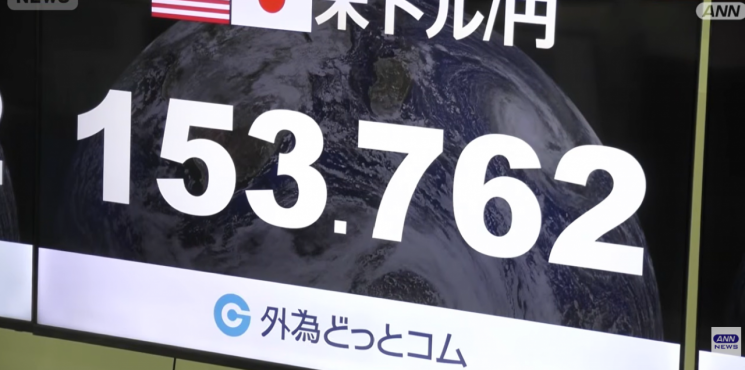
Japanese ANN News reports that the value of the yen has risen to the 153 yen level against the dollar, showing the electronic board. ANN.
The Nikkei pointed out that the current yen appreciation appears to be driven by a combination of several factors: the possibility that U.S. and Japanese monetary authorities may step in again to intervene in the foreign exchange market, and expectations that the BOJ could accelerate its pace of rate hikes.
First, there is growing speculation in the foreign exchange market that monetary authorities in both countries could take concrete measures to address yen weakness later this month. On August 30, U.S. Treasury Secretary Scott Bessent met with BOJ Governor Kazuo Ueda, commenting, “We strongly support Japan taking decisive market and financial policy actions to address the significant undervaluation of the yen.” Japan’s Finance Minister Satsuki Katayama has also signaled that further intervention in cooperation with the United States could be on the table if the yen’s excessive weakness continues.
Expectations that the BOJ will accelerate its rate hikes are also fueling yen purchases. The market is increasingly factoring in the possibility that the BOJ could raise its policy rate by 0.25 percentage points at its upcoming Monetary Policy Meeting on September 17-18. Additionally, investors are betting on further potential rate increases. The Nikkei reported, “There is growing speculation that after this rate hike, the BOJ could continue raising rates at a pace of once every three months, or that the final policy rate target could be revised upward.”
Expectations that tensions in the Middle East may ease are also contributing to the yen’s strength. Esmail Baghaei, spokesperson for Iran’s Foreign Ministry, stated the previous day that negotiations with Oman over a temporary route in the Strait of Hormuz had reached a final stage and that an agreement could be reached within days. As a result, the ‘buy-the-dollar-in-times-of-crisis’ phenomenon, previously seen as investors sought safety, has eased.
The yen’s rapid appreciation is also accelerating the unwinding of positions by investors who had bet on yen weakness. As losses from the strengthening yen grow, traders are selling dollars and buying back yen, adding to the currency’s upward momentum. Yusuke Okada, Senior Analyst in the Treasury and Foreign Exchange Department at Mitsubishi UFJ Trust and Banking Corporation, told the Nikkei, “Not only hedge funds and other short-term speculative players, but also those trading from a mid- to long-term perspective are unwinding their yen-sell/dollar-buy positions, indicating a shift in recent trends.”
Furthermore, the breach of the 155-yen-per-dollar mark triggered a cascade of stop-loss orders. Citing anonymous traders, Bloomberg reported that large stop-loss orders set just below 155 yen were executed as the yen strengthened, and option dealers also moved to sell dollars, further contributing to the yen’s rise.
With these complex factors overlapping, there are now assessments that this yen surge differs from the previous government-led intervention. Van Lu, Head of Global Fixed Income and Currency Solutions Strategy at Russell Investments, told Bloomberg, “The effects of the first market intervention seem to have already dissipated. This second round of appreciation appears to be driven by market forces, which makes this move far more significant.”
Hot Picks Today

There are also projections for further gains. Daisaku Ueno, Chief Foreign Exchange Strategist at Mitsubishi UFJ Morgan Stanley Securities, told the Nikkei, “Since the yen has breached the psychologically important resistance at 155, more yen buying could flow in over the short term.” He added, “For now, there is room for the yen to rise back to the year’s high in the 152-yen range.”
This content was produced with the assistance of AI translation services.
© The Asia Business Daily. All rights reserved. Unauthorized AI training and use prohibited.