
Riding on higher exchange rate caused by demand spikes to settle government imports later last month, they noted, remitters sent home a significant sum of foreign currencies while export receipts were also on an upturn.
As a matter of fact, according to them, the foreign-exchange netting by commercial banks was enhanced significantly by end of July last. But the demand plummeted after government import settlement from early this month, which caused the exchange rate drop by more than Tk 1.0.
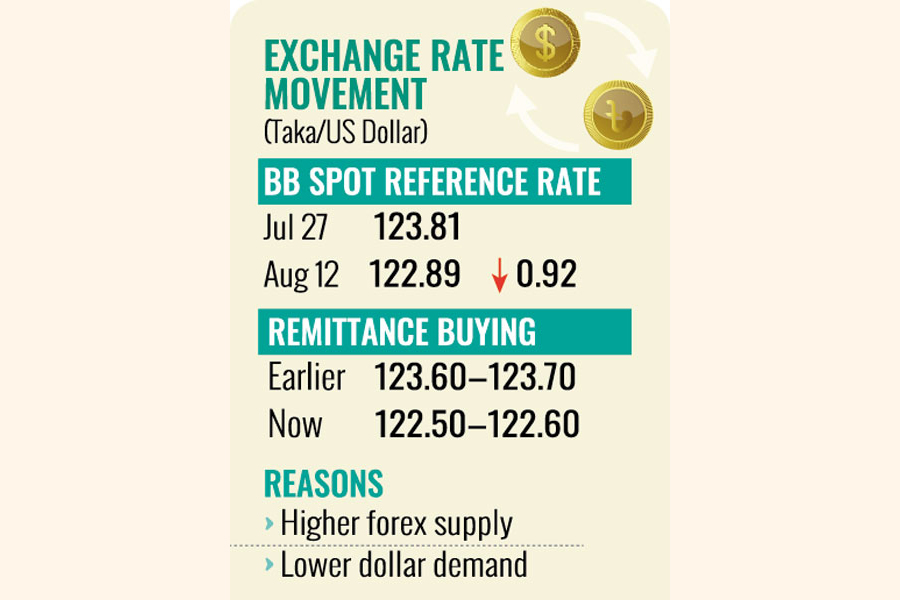
According to the treasury officials of commercial banks, bankers are now buying the US dollar from the remitters at rates in-between Tk 122.50 and Tk 122.60 apiece. The exchange rate against remittance was hovering from Tk 123.60 and Tk 123.70 each dollar couple of weeks earlier.
Such drop in exchange rate was also reflected in forex-market spot reference rate (RR) regularly released by the central bank, which declined to Tk 122.89 a dollar until August 12, 2026 from Tk 123.81 recorded on July 27, 2026.
Seeking anonymity, a Bangladesh Bank official said the exchange rate dropped significantly in recent days mainly because of the much higher supply than its demand.
“Because of the supply-side boost,” he said, “majority of the banks are in a long position in terms of forex holdings, which means the banks have more than enough stock of dollars than their demands.”
The central banker also informed that the banking regulator earlier had halted dollar purchase from the market as part of its intervention to stabilise the exchange rate.
“All of these factors,” he said, “pushed up the net open position (NoP) of US dollars in the banking industry that rose over $1.0 billion now.”
On condition of anonymity, the treasury head of a commercial bank said there was no big pressure of demand as most of the government import liabilities have already been settled.
“So, banks are not interested to buy remittance at higher rate from exchange houses. This is the reason behind the continuous fall in exchange rate.”
As a spillover effect, the exchange rate on the kerb market also dropped below Tk 126 a dollar now from Tk 127 a week ago.
Meanwhile, the BB has withdrawn the mandatory 100-percent cash margin requirement for fruit imports, citing improved stability on the foreign-exchange market and in reserves.
Under the new decision, the cash margin for opening letter of credit (LC) for fruit import will now be determined based on the banker-customer relationship, according to a latest circular issued by the central bank.
The regulator had imposed the 100-percent cash-margin requirement in September 2024 as part of measures to conserve foreign currency and discourage import of nonessential goods.
Under the earlier arrangement, importers of foreign fruits could not avail themselves of any credit facility from banks and had to deposit the full amount in cash before opening LCs.
The country’s current foreign-exchange reserves stand around $37 billion by BB count while IMF measure puts it over $32 billion.