
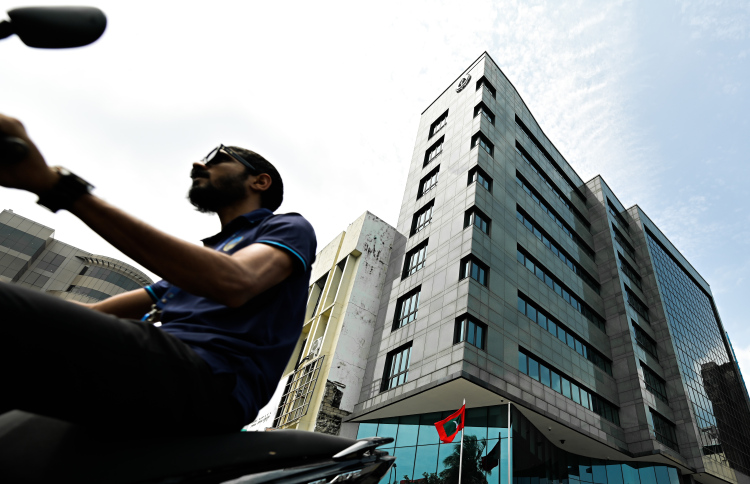
Maldives Monetary Authority (MMA) decided to publicize the names of resorts that do not exchange foreign currency at all as required under the Foreign Exchange Act, releasing two names today.
According to the list published by MMA, the entities failing to exchange dollars in accordance with the Foreign Exchange Act are Raha Resort and South Palm Resort Maldives.
Opened in L. Atoll in 2019, Raha Resort is operated by Heavy Load Maldives, in which former Deputy Speaker of the Parliament and former MDP Chairperson Moosa Manik (Reeko Moosa) holds shares. The shareholders of South Palm, located near Meedhoo in Addu, are Ibrahim Saleem (Bandhu Saleem) and tourism sector veteran Moosa Didi.
MMA has urged parties required to exchange currency under the Foreign Exchange Act to proceed with exchange arrangements in accordance with the law and regulations. It also stated that a final opportunity is being given to entities that have not yet registered with the MMA.
According to the MMA, a majority of resorts are exchanging foreign currency in compliance with the law.
Compliance reports publicized by the MMA show that 78 percent of resorts have properly carried out USD exchange arrangements. The report notes that 20 percent of resorts are not carrying out dollar exchange arrangements in the most optimal manner.
Although most resorts within this 20 percent have requested concessions for various reasons, MMA reminded these parties to fulfill their required obligations according to established rules.
Looking at Category B of the report published by the central bank, 48 percent of registered tourism establishments in that category have properly carried out currency exchange arrangements. Meanwhile, 15 percent of parties are not conducting exchanges in the best manner. The report also highlights that 37 percent of establishments have not exchanged dollars at all.
As these places generally consist of small and medium enterprises, the MMA noted that efforts are underway to grant additional opportunities within the law and conduct further awareness work to improve compliance. Category B includes places such as guesthouses, tourist hotels, safaris, and homestays.
Category C comprises businesses generating annual revenues exceeding 15 million dollars.
Among establishments in this category, 38 percent have properly carried out dollar exchange arrangements. Thirty-three percent of businesses are not conducting dollar exchanges in the most optimal manner.
Twenty-nine percent of establishments in this category have not exchanged dollars at all. These businesses have also requested concessions. However, as decisions regarding these businesses can only be made by amending the law, MMA stated that proposals to amend the law have been submitted.
Under the Foreign Exchange Act, 90 percent of exchanged dollars are taken into MMA. Out of this, 30 percent is released by the MMA to banks, with priority given to Maldivian banks in this distribution.
There are also specific purposes for which this 30 percent returned to banks must be used. These include expenditure for various essential needs of the public and the import of food items. Additionally, a large percentage of this amount is used to provide foreign exchange assistance needed by small and medium enterprises.