

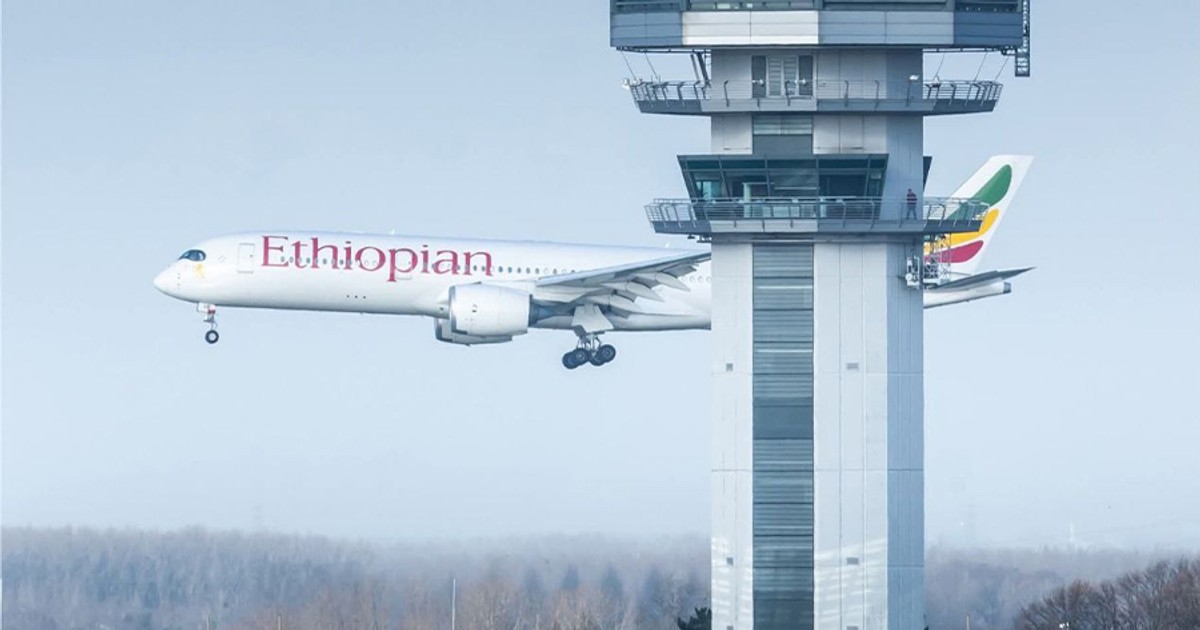
Ethiopian Airlines Chief Commercial Officer Lemma Yadecha told Addis Ababa-based The Reporter that about $45 million remains inaccessible in Russia after sanctions imposed over the war in Ukraine disrupted normal international banking channels.
Russian banks have faced restrictions on access to the SWIFT payments network, preventing Ethiopian Airlines from transferring revenue through its usual correspondent banks in countries including the United States, United Kingdom, United Arab Emirates and Germany.
“Due to sanctions, we cannot transfer funds through standard bank-to-bank transfer systems,” Lemma said.
The airline continues to operate daily flights to Russia and uses some of its rouble earnings to cover local costs, including fuel, crew expenses, ground handling and overflight charges. However, it has been unable to repatriate the remaining net earnings.
Ethiopian Airlines is working with Ethiopia’s Ministry of Foreign Affairs and diplomatic missions to find a solution.
Africa bears the brunt of blocked airline funds
The remaining $45 million is spread across other overseas markets, including Mozambique and Angola, where foreign-currency shortages and delays in central-bank allocations have slowed transfers.
Unlike the funds in Russia, Ethiopian Airlines said the money in those markets is not permanently frozen.
Transfers continue when foreign currency becomes available, although delays leave airlines exposed to exchange-rate losses when local currencies weaken before revenues are converted.
The problem extends far beyond Ethiopian Airlines.
The International Air Transport Association said $1.2 billion in airline revenues remained blocked worldwide at the end of October 2025, with Africa and the Middle East accounting for 93%, or about $1.12 billion.
African markets dominate the list. Algeria had the largest amount of blocked airline funds at $307 million, followed by the six-country Central African CFA franc zone at $179 million.
Mozambique accounted for $91 million, Angola $81 million, Eritrea $78 million and Zimbabwe $67 million. Ethiopia itself had $54 million in blocked airline funds across carriers.
IATA has linked the problem to foreign-exchange shortages, administrative approval delays and broader economic instability.
For African aviation, the pressure is particularly significant because airlines earn much of their revenue in local currencies while paying major costs such as aircraft leases, maintenance, fuel and insurance in dollars.
Blocked revenues can therefore weaken cash flow, raise operating risks and make it harder for carriers to maintain international routes.
Ethiopian Airlines expands despite cash constraints
The trapped funds come as Ethiopian Airlines pursues one of Africa’s largest aviation expansion programmes.
The airline generated a record $7.6 billion in revenue in the financial year ended June 2025, up 8% year-on-year, while carrying 19 million passengers, including 15.1 million on international routes.
At the same time, it is developing the $12.5 billion Bishoftu International Airport south of Addis Ababa, with an initial capacity of 60 million passengers a year and eventual capacity of 110 million.
The airport is being designed and supervised by Dar Al-Handasah Consultants, working with Zaha Hadid Architects, one of the world’s best-known architecture firms.
The project has also become a new arena for U.S.-China competition in Africa. Chinese state-owned firms including China Communications Construction Company, China Road and Bridge Corporation and China Civil Engineering Construction Corporation are among those shortlisted for major construction packages, while Washington is pushing for greater participation by U.S. companies.
Meanwhile, U.S. officials have pointed to Boeing and GE Aerospace as companies that could benefit from future aircraft, engine, technology and equipment opportunities linked to Ethiopian Airlines’ expansion.
Separately, the African Development Bank has committed $500 million and is helping mobilise additional financing for the project, which is scheduled for completion in 2030.
Against that expansion backdrop, Ethiopian Airlines has confirmed that Group Chief Executive Mesfin Tasew will remain in office after the board extended his tenure for an undisclosed period.