

Summary:
A detailed explanation of creating a unified trading network for global stablecoins and foreign exchange liquidity, Mobius Exchange, and building an AI Agent coordination network, Aivive, across data and execution environments.
1. Summary of Macro Level and Future Predictions
This week’s macro summary (2026/7/20–2026/7/26)
This week, the global macro market revolves around three main lines: central bank policies, energy prices, and trade frictions. The European Central Bank maintains a cautious hawkish stance, and in the context of energy prices rebounding due to the Middle East situation and inflation remaining above target, the market begins to reprice expectations for subsequent interest rate hikes; in the United States, the Federal Reserve enters a silent period before the interest rate meeting, and the market shifts focus to the FOMC meeting at the end of July. Meanwhile, the preliminary PMI data for July from the U.S., Europe, and the UK shows that the economy remains resilient, but manufacturing and business confidence are dragged down by high interest rates, tariffs, and geopolitical factors. At the same time, the U.S. expands tariff measures, and the fluctuating situation in the Middle East leads to a spike in oil prices, causing global inflation expectations to rise again, bond yields to increase overall, and market risk appetite to cool down.
Future week forecast (2026/7/27–2026/8/2)
In the coming week, the market will welcome the most important macro window period of this round, with major central bank meetings such as the Federal Reserve, the Bank of England, and the Bank of Japan being held successively. Among them, the Federal Reserve’s interest rate decision on July 30 is expected to become the core driving factor for global asset prices, with the market paying more attention to its guidance on the subsequent interest rate path rather than whether to adjust rates immediately. At the same time, U.S. PCE inflation, non-farm employment forecasts, Eurozone GDP, and inflation data will further verify whether the global economy continues the pattern of “slowing growth but persistent inflation.” If energy prices remain high and trade frictions continue to escalate, the probability of the Federal Reserve and other central banks maintaining a hawkish stance will further increase, and global risk assets are expected to maintain high volatility in the short term, with the market paying more attention to the impact of macro policy changes on liquidity and risk appetite.
2. Market Changes and Warnings in the Crypto Industry
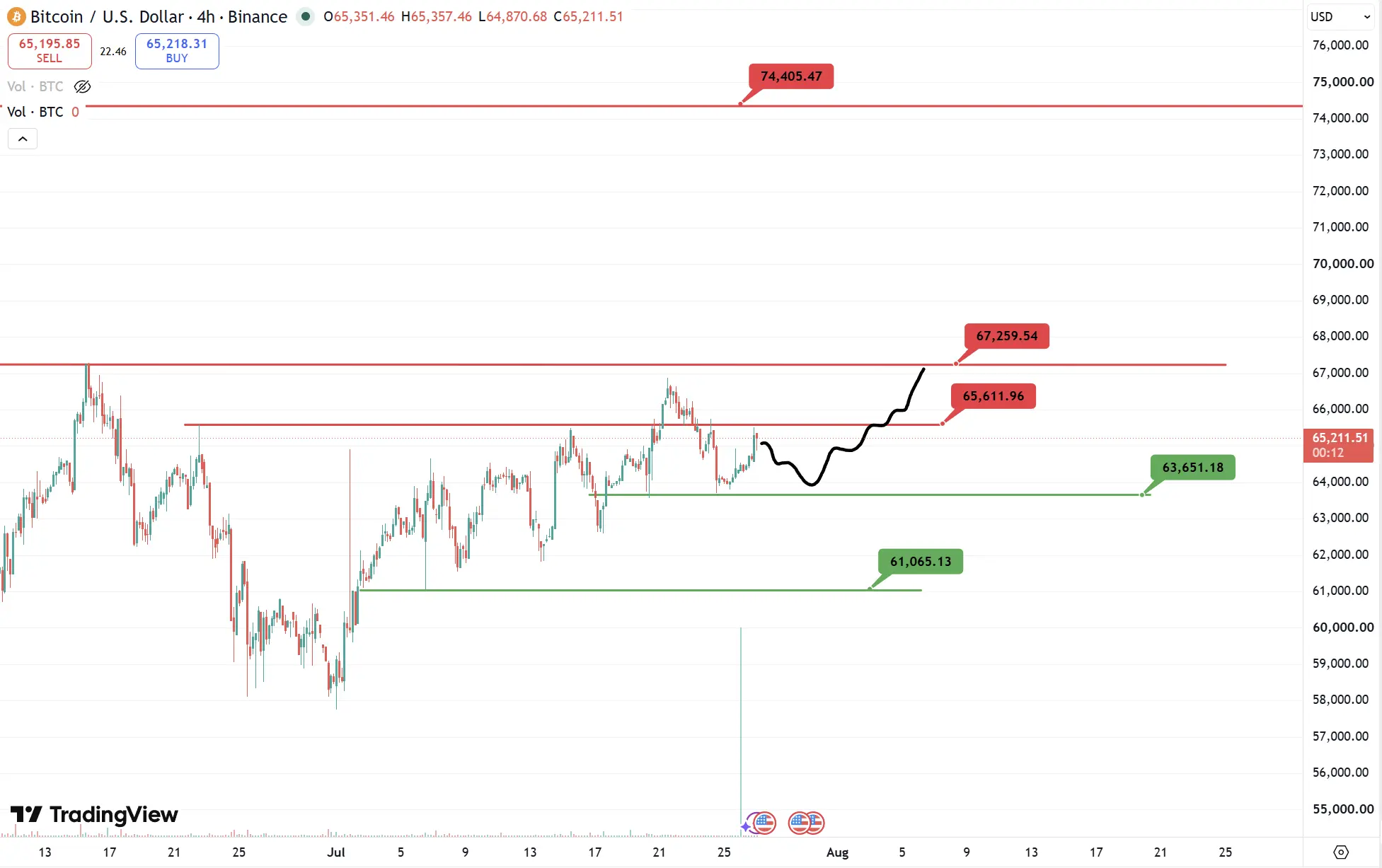
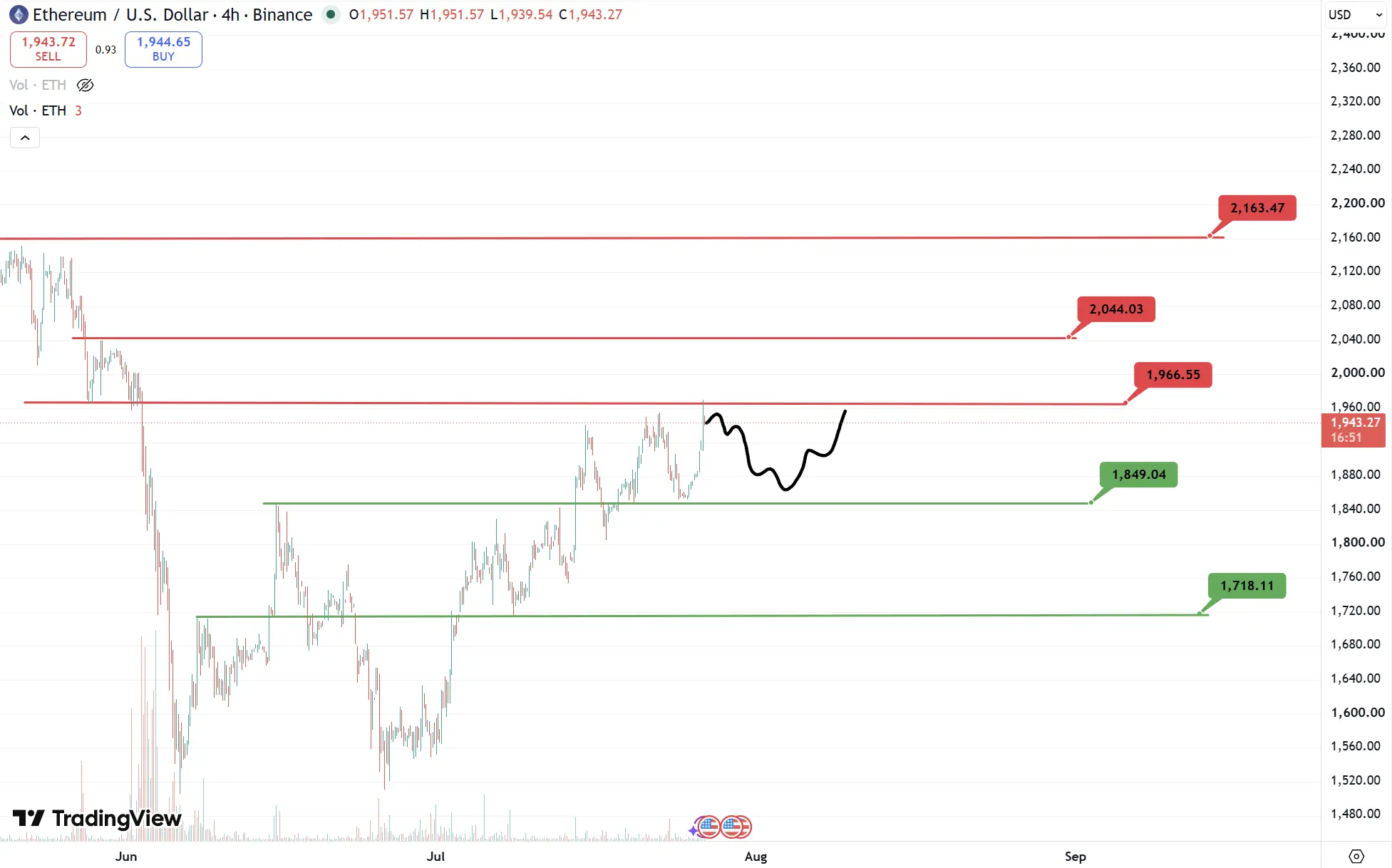
This week, the overall crypto market maintained a volatile recovery trend. BTC opened at around $65,200 at the beginning of the week, influenced by the reflow of funds into U.S. spot ETFs and improved market expectations for crypto regulation, rising above $66,000 at one point. However, it later fell back due to a decline in macro risk appetite, returning to around $64,000 by the weekend, with an overall weekly fluctuation range of about $63,000 to $66,000. ETH performed weaker than BTC, starting at around $1,900 and then fluctuating in the $1,850 to $1,900 range, with market funds still mainly concentrated on BTC ETFs and institutional allocations. This week’s main market drivers came from two aspects: one is the continuous net inflow of funds into BTC spot ETFs, improving market liquidity expectations.
In the coming week (July 27 – August 2), the market will focus on the Federal Reserve’s interest rate meeting, the sustainability of ETF funds, and changes in macro liquidity. The short-term key positions for BTC are the support level of $63,000 and the resistance level of $66,000: if ETF funds continue to flow in and break through $66,000, the market may further test the $68,000 to $70,000 area; if it falls below $63,000, it may retest support near $60,000. For ETH, the short-term focus is on the support at $1,850 and the resistance at $2,000. If funds flow back into ETH ETFs, DeFi, and on-chain application ecosystems, it is expected to drive ETH’s rebound.
3. Industry and Track Hotspots
From July 20 to July 26, 2026, the hot topics in the crypto industry mainly revolved around RWA, stablecoins, AI Agents, and institutional-level financial infrastructure. The RWA track continues to become a key layout direction for institutional funds, with market focus shifting from purely asset tokenization to asset infrastructures that have real yields, liquidity, and DeFi composability, with tokenized government bonds, fund shares, and credit assets remaining the main directions.
The stablecoin ecosystem continues to evolve towards payment and financial infrastructure, with more projects building underlying networks around stablecoin settlement, cross-border payments, and institutional fund management, driving the crypto industry from transaction-driven to finance application-driven. The AI+Crypto direction continues to focus on AI Agent autonomous execution, on-chain payments, and smart asset management, with industry focus gradually shifting from conceptual hype to verifiable automated execution capabilities and practical application scenarios.
In terms of financing and industry cooperation, traditional financial institutions continue to accelerate their entry into the digital asset field, with institutional-level trading, asset tokenization, and compliance infrastructure becoming the focal points of capital attention, further enhancing the trend of integration between Crypto and TradFi.
1. Overview of Potential Projects
1.1. Analysis of Total Financing Unknown, but led by well-known VC YZiLabs, with follow-up investments from Finality, L2IV, SNZ, and the Rollup, aiming to create a unified trading network for global stablecoin and foreign exchange liquidity, Mobius Exchange
Introduction
Mobius is the Prime Brokerage Layer in the DeFi space, providing users with Unified Margin, Cross-Collateralization, and leveraged trading capabilities across multiple perpetual contract DEXs and blockchain ecosystems.
The goal of Mobius is to become the prime brokerage infrastructure for DeFi, allowing users to trade under a unified account system without having to manage funds and margins separately across multiple protocols.
With Mobius, users can:
-
Manage multiple positions using unified margin
-
Use different assets as shared collateral
-
Flexibly allocate leverage across multiple perpetual contract exchanges
-
Execute trades across multiple blockchain ecosystems
Thus achieving capital efficiency and trading experience similar to that of hedge funds in traditional finance.
Brief Description of the Protocol Mechanism
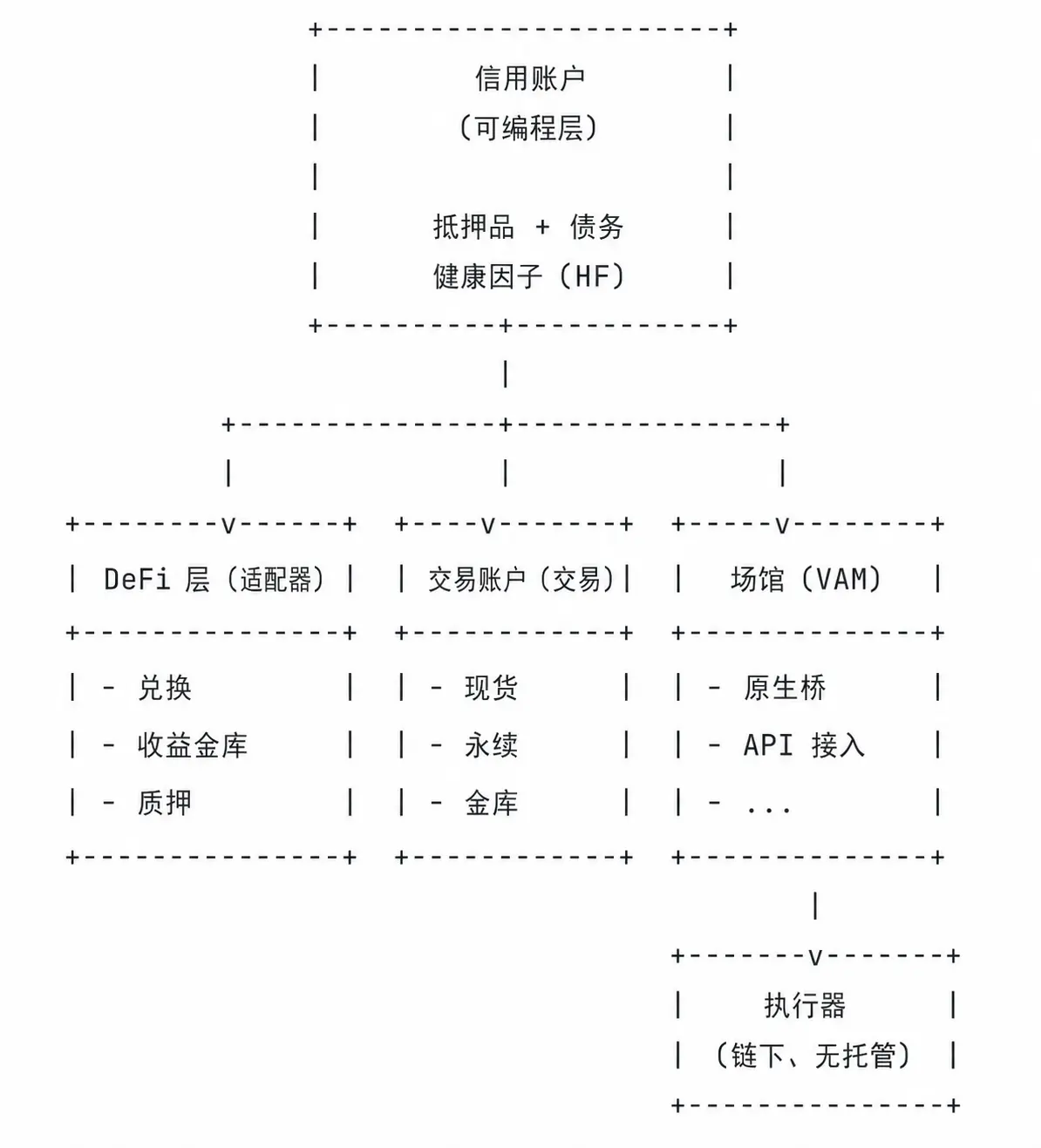
Mobius connects fund providers, traders, credit accounts, trading accounts, and external perpetual contract exchanges through a unified margin account system, enabling cross-platform capital management and leveraged trading.
Core Participants (Roles)
Lenders (Fund Providers / LP)
LPs provide funds to Mobius’s lending market.
Their income comes from:
Borrowers (Borrowers / Traders / Strategy Executors)
Users can:
Supported collateral assets include:
-
Stablecoins
-
BTC
-
ETH
-
Yield Assets
Executors (Execution Nodes)
Execution nodes are off-chain service providers.
Main responsibilities include:
Importantly:
Executors never hold user funds.
Their responsibilities are limited to information transmission and state synchronization.
Trading Lifecycle
- Lend (Provide Liquidity)
LPs deposit assets into the lending pool.
The system provides these funds for traders to borrow.
LPs continuously earn interest based on borrowing demand.
- Open a Credit Account
Traders first create:
Credit Account
This is the core account system of Mobius.
It mainly records:
-
Collateral
-
Borrowed amount
-
Risk parameters
-
Health Factor
The system continuously checks:
All operations must maintain sufficient collateralization.
To avoid bad debt risks in the account.
- Open a Venue Account
Within the Credit Account,
Users can further create:
Venue Account
Used to connect to specific trading venues.
Supports:
- Bind External Venues
Through:
Venue Account Model
Users can bind their Credit Account to multiple external perpetual contract trading platforms.
Including:
-
Hyperliquid
-
GMX
-
Vertex
-
Drift
-
Other Perp DEXs
System Composition:
Onchain Driver
Responsible for:
Offchain Executor
Responsible for:
-
Interacting with external exchanges
-
Executing trading instructions
-
Returning execution results
- Execute Strategies
Mobius allows users to run complex strategies.
For example:
Delta Neutral Carry Trade
Combining:
While obtaining:
-
Base yield
-
Funding rate income
And reducing market directional risk.
- Unified Accounting
This is one of Mobius’s core innovations.
In traditional DeFi:
Are usually independent of each other.
Mobius unifies the calculation of:
Credit Account Equity
Including:
-
On-chain collateral
-
Venue Account funds
-
Perpetual position value
-
Account snapshot data
Together forming:
Global Health Factor
Therefore:
Assets in external trading accounts can also be considered collateral.
Significantly improving capital efficiency.
- Rebalance (Automatic Rebalancing)
Due to:
-
Credit Account
-
Venue Account
They essentially still belong to two independent margin systems.
Therefore, dynamic adjustments of fund distribution are needed.
Users or automated bots (Rebalancers) will:
To avoid positions being liquidated.
Lending System
Money Market Model
-
LPs deposit assets such as USDC into the lending pool to earn interest income.
-
Borrowers borrow funds through the Credit Account for trading and strategy execution.
-
Adopts a Non-Rehypothecation design, where collateral is not re-borrowed but remains in the borrower’s account, reducing systemic risk and simplifying the liquidation process.
Market Structure
-
Each market consists of Collateral and Debt Token.
-
The first Core Market supports:
-
Collateral: BTC, ETH, native tokens of trading platforms
-
Lending assets: USDC
-
Future Permissionless Markets will be opened, allowing the community to create custom lending markets.
Interest Rate Model
-
Low utilization: Borrowing rates are low, attracting borrowing demand.
-
High utilization: Borrowing rates increase, encouraging repayments and attracting more liquidity.
-
Kink Point: When the utilization rate exceeds a set threshold, the interest rate will rise rapidly to protect the liquidity of the fund pool.
Core Value
Mobius’s lending system is essentially the liquidity underpinning its Prime Brokerage architecture, supporting cross-platform unified margin and leveraged trading through unified fund pools, non-rehypothecation mechanisms, and dynamic interest rate models, while achieving risk isolation and improving capital efficiency.
Credit Account
Core Positioning
The Credit Account is a dedicated smart account created by Mobius for each borrower and is the core of the entire unified margin system.
Its main functions are:
-
Storing user collateral and borrowed funds
-
Executing on-chain trades and strategy operations
-
Managing risk and leverage
-
Unified calculation of account health (Health Factor)
Although users can borrow funds for trading, the borrowed funds always remain within the account system, thus the protocol overall maintains an over-collateralized state.
Account Structure
The Credit Account consists of two parts:
① User Interaction Layer
Responsible for:
-
Opening accounts
-
Depositing collateral
-
Borrowing
-
Executing trades
-
Closing accounts
② Risk Engine
Responsible for:
All operations must be validated by the risk engine.
Permitted Assets
Each Credit Account belongs to a specific market.
For example, if the market supports:
As collateral, and USDC as the lending asset,
Then the account can only hold:
This restriction can:
Adapters
The Credit Account interacts with external DeFi protocols through whitelisted Adapters.
Supports:
-
DEX swaps
-
Yield vault deposits
-
Liquidity provision (LP)
Adapters are essentially a secure interface layer, ensuring all external operations comply with the risk rules of the Credit Account.
Health Factor Mechanism
The Health Factor (HF) is an account risk indicator.
Simplified understanding:
HF = Risk-adjusted collateral value ÷ Total debt
Where:
Mobius continuously monitors account health. Any operation completed must satisfy HF ≥ 1; otherwise, the transaction will be rejected.
Multicall
The Credit Account supports completing multiple operations in one transaction.
Venue Account
The Venue Account is the actual trading account for users on external trading platforms (Perp DEX), managed uniformly by the Credit Account.
Users can use the Venue Account to:
At the same time, its account equity will be counted as collateral value in the Credit Account, achieving unified margin management.
Unified Margin Mechanism
The core innovation of Mobius is that the funds and position values in the Venue Account can be used as collateral for the Credit Account. Therefore, users do not need to prepare margin separately across multiple exchanges.
The system will uniformly calculate:
-
On-chain collateral value
-
Venue Account fund balance
-
Perpetual position equity
-
Unrealized PnL
Together forming the Global Health Factor.
Risk Control
All Venue Account operations will undergo pre-checks before being submitted to the trading platform.
The system will verify:
Global Health Factor ≥ 1
If a trade may cause the account health to fall below the safety threshold:
Controlling risk from the source.
Venue Account Model (VAM)
Mobius connects the Credit Account with multiple external trading platforms through the VAM (Venue Account Model).
Its core components include:
① VenueRegistry
Maintains a list of integrated trading platforms on-chain.
Recorded content includes:
-
Venue ID
-
Corresponding Driver
-
Margin type
Equivalent to the trading platform directory for the entire system.
② VenueDriver
Each trading platform corresponds to an independent Driver.
Responsible for implementing three types of functions:
Binder
-
Creating accounts
-
Binding accounts
-
Unbinding accounts
Reader
Writer
-
Submitting orders
-
Depositing
-
Withdrawing
Essentially a unified adaptation layer for different exchanges.
③ Executor
The Executor is an off-chain execution service.
Main responsibilities include:
-
Receiving on-chain trading intentions
-
Calling external trading platform APIs
-
Executing actual trades
-
Synchronizing results back on-chain
It should be emphasized that:
Executors do not hold user funds, only responsible for execution and information transmission.
Executors
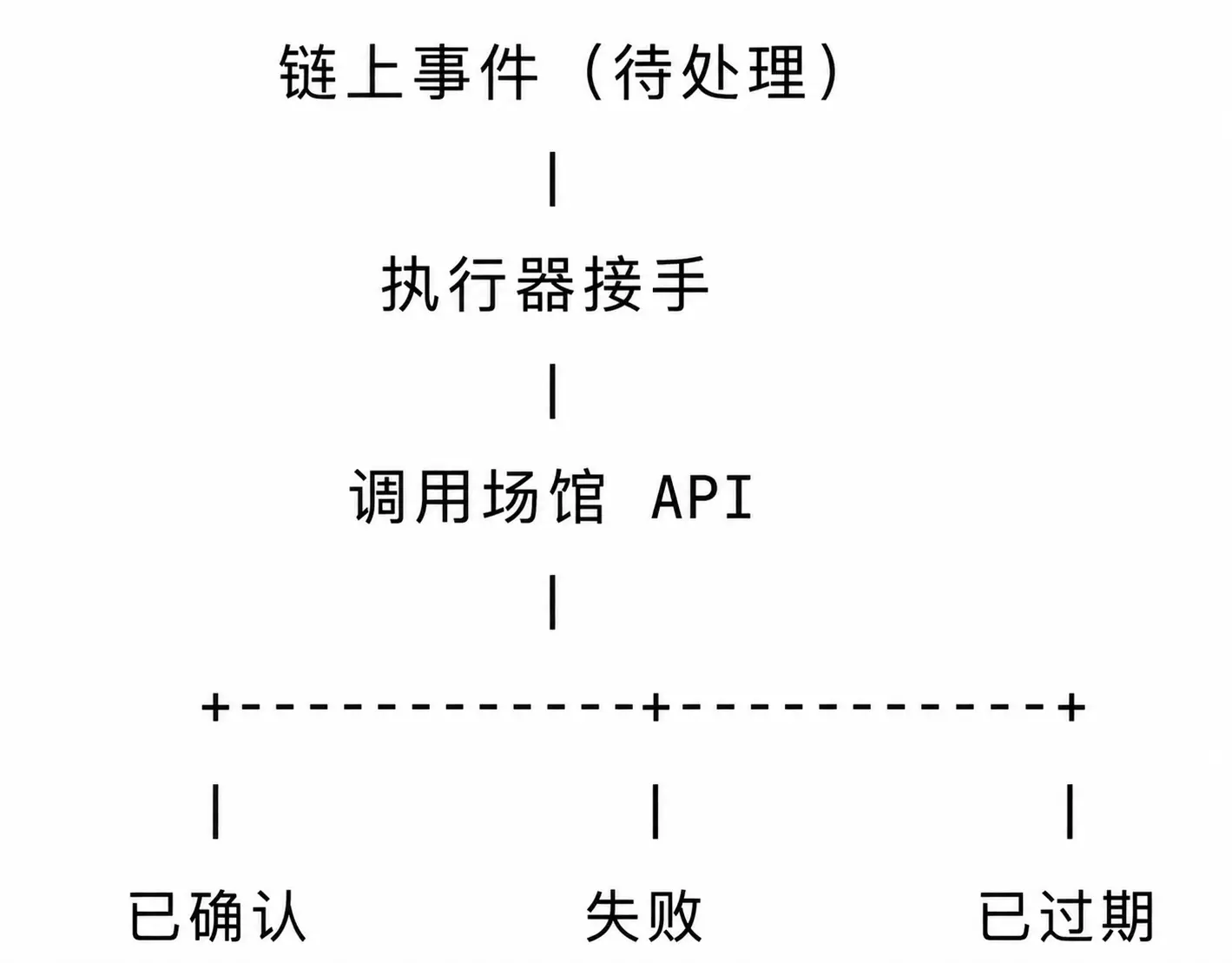
Executors are the state relay layer connecting external trading platforms with the Mobius risk control system.
Main responsibilities:
-
Obtaining fund, position, and margin data from the Venue Account
-
Generating and signing account state snapshots
-
Synchronizing snapshots to the on-chain risk control engine
-
Executing orders, deposits, withdrawals, and other trading instructions
Their characteristics include:
-
Using MPC multi-node signature mechanisms
-
Not holding user funds
-
Only executing authorized requests
-
Automatically reducing account leverage capacity when data stops updating
Essentially, Executors are responsible for ensuring that Mobius can grasp the status of external trading accounts in real-time, thus accurately calculating the global Health Factor.
Rebalancers
Rebalancers are off-chain Keepers responsible for account maintenance and automated fund management.
Main responsibilities:
-
Retrying failed or delayed cross-chain transactions
-
Executing liquidations (HF < 1)
-
Automatically allocating funds between Credit Account and Venue Account
-
Automatically taking profits, repaying debts, and supplementing margins
For example:
Mobius’s advantage lies in its attempt to introduce the Prime Brokerage model from traditional finance into DeFi, allowing users to share capital and risk exposure across multiple perpetual contract exchanges through Unified Margin, Cross-Collateralization, and cross-platform position management, significantly improving capital utilization; at the same time, the Credit Account, Venue Account, Executors, and Rebalancers together build a unified risk control system, enabling complex strategies (such as Delta Neutral, cross-platform arbitrage, etc.) to be executed efficiently on-chain and possessing capabilities similar to institutional-level trading infrastructure.
Its disadvantage is that the overall architecture is relatively complex, highly dependent on the stable operation of external trading platforms, state synchronization networks (Executors), and automated maintenance systems (Rebalancers), with system design and operational maintenance thresholds far exceeding those of ordinary DeFi protocols; in addition, the multi-layer account structure and cross-platform risk management also increase the difficulty of risk control. In the event of extreme market fluctuations, state delays, or external platform risks, additional pressure may be placed on the unified margin system.
2. Detailed Explanation of Key Projects of the Week
2.1. Detailed Analysis of Total Financing of $8 Million, led by VEGA, UZ Capital, and Echo3, with follow-up investments from OKX, Consensys, and Arweave—building a cross-data and execution environment AI Agent coordination network, Aivive
Introduction
Aivive is the first Recursive AI Protocol (RAP)—a type of on-chain economic system where the core mechanism is that user behavior using AI products directly drives the continuous compression of the underlying asset supply of the protocol, and this process is automatically completed by the protocol mechanism without any intermediaries involved.
The protocol automatically and verifiably executes a portion of the platform revenue generated by AI generation tools on-chain according to preset rules, permanently reducing the circulating supply of AVV tokens.
Users do not need to hold AVV tokens to use the products. At the same time, the platform itself will not retain revenue as intermediary profits like traditional internet platforms.
On the contrary, the entire economic cycle is completely open, transparent, and auditable:
-
Users generate income from using products;
-
Income is automatically converted into AVV supply contraction;
-
The circulating supply of AVV continuously decreases;
-
Network value grows in sync with the cultural influence of applications and the scale of user usage.
Therefore, Aivive aims to establish a new value closed loop:
The higher the product usage → The higher the protocol income → The lower the AVV supply → The stronger the network value growth.
Its core idea is to directly bind the real usage demand of AI products with token value, achieving “Usage-to-Scarcity” through on-chain verifiable mechanisms, rather than relying on speculation or human intervention to support token value.
Core Analysis of System Architecture
1. Aivive Network
Network Positioning: Recursive AI Protocol (RAP)
Aivive is not a Layer 1 or sidechain, but the first Recursive AI Protocol.
Its core idea is that the actual usage behavior of AI products will automatically convert into token supply contraction, thus forming an on-chain economic cycle of “usage growth → value growth.”
Aivive chooses to build directly on mature public chains rather than creating its own blockchain:
-
Solana: Responsible for AVV token issuance, liquidity, and destruction
-
Base: Responsible for collecting AI product revenue and user payments
By leveraging the existing security, liquidity, and infrastructure of these two ecosystems, it reduces construction costs and improves scalability.
Cross-Chain Architecture
Aivive operates on a dual-chain architecture:
Solana
Responsible for:
Base
Responsible for:
Cross-chain connection
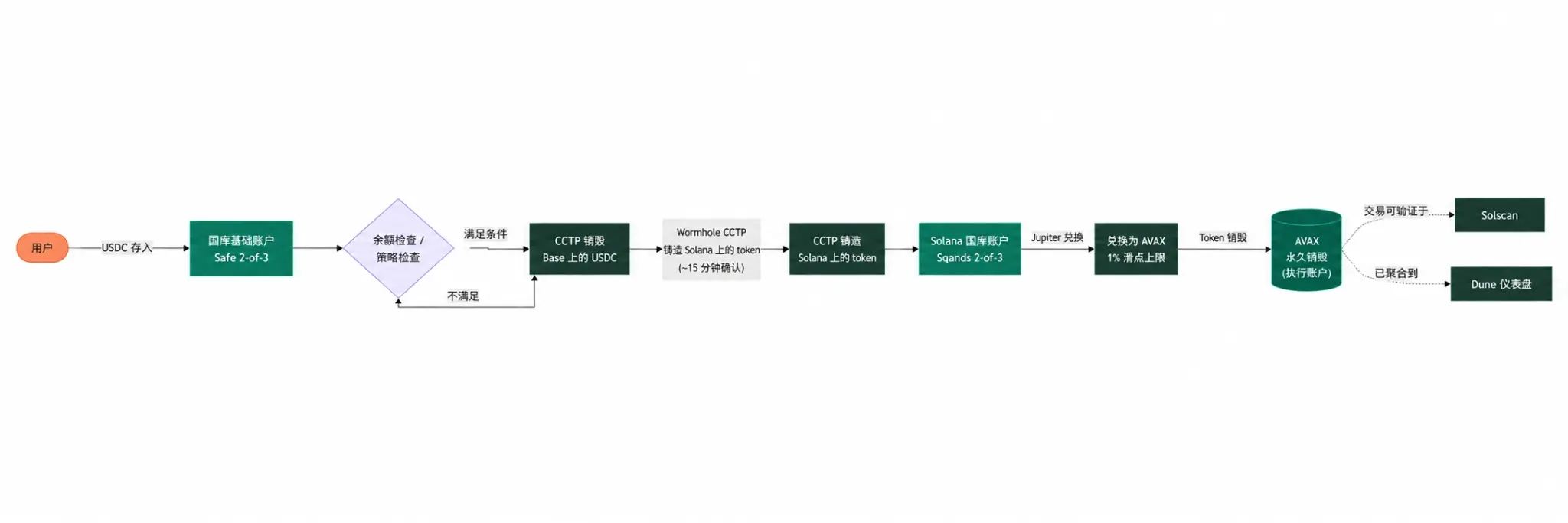
Uses Circle’s official CCTP (Cross-Chain Transfer Protocol):
No third-party cross-chain bridges or custody pools are needed, enhancing security.
Buyback & Burn Mechanism
Aivive’s core economic model is an automated buyback and burn cycle.
Automated Execution Mechanism
The buyback and burn process is automatically executed once a week:
-
Check Treasury USDC balance
-
If it reaches the threshold, initiate cross-chain
-
Automatically buy AVV
-
Automatically burn AVV
The only human participation step is:
But the signature rules and execution conditions are publicly disclosed in advance.
Transparency Design
The project will publicly display:
All data can be verified in real-time through:
-
Solscan
-
Dune Analytics
-
Aivive Dashboard
Core Value
Aivive essentially builds an automated on-chain economic system of:
AI product revenue → USDC income → Buyback AVV → Burn AVV → Supply contraction.
Unlike traditional AI projects that rely on token incentives, Aivive attempts to directly bind real product revenue with token deflation mechanisms, making network value growth stem from the actual usage demand of AI products rather than mere market speculation.
2. Architecture & Technology
System Architecture
Aivive adopts a lightweight, serverless architecture design to reduce operational costs and improve scalability.
The core tech stack includes:
-
Frontend application: Next.js + Vercel
-
Database: Supabase Postgres
-
Storage layer: Cloudflare R2
-
Task scheduling: Inngest (AI generation, content review, burn process)
-
Base chain interaction: viem + wagmi
-
Solana chain interaction: @solana/web3.js + Squads Multisig
Account and Wallet System
Achieves a seamless Web3 login experience through Privy.
Each user automatically generates:
Supports:
-
Email login
-
Google login
-
Apple login
Users do not need to install wallets, manage mnemonic phrases, or hold cryptocurrencies in advance.
AI Model Routing Mechanism
Aivive uses a unified AI gateway to automatically select model suppliers based on demand:
This design allows the platform to dynamically switch model service providers and optimize costs.
Content Review System
Adopts a dual-layer review mechanism:
Text review
Image review
- fal.ai NSFW detection model
For borderline content:
- Enters manual review queue (processed within 24 hours)
Violating content:
Simultaneously establishes keyword and semantic blacklists covering:
-
Political figures
-
Celebrities
-
Minors
-
Violent content
-
Hate speech
Credit Ledger System
Aivive employs an immutable dual-entry bookkeeping system to manage user points.
Recorded content includes:
All records are permanently saved and cannot be modified.
When users recharge USDC on Base:
-
Alchemy Webhook automatically listens for payments
-
Synchronizes to the ledger within seconds
-
Automatically increases user points balance
Thus forming:
USDC payment → Point issuance → Closed loop of product usage for AI generation consumption.
Monitoring and Observability
Full-link monitoring of the system:
-
Sentry: Application error monitoring
-
PostHog: User behavior analysis
-
Vercel Analytics: Performance monitoring
Additionally:
Public data panels display in real-time:
-
Total AVV burned
-
Weekly burn rate
-
AVV circulating supply
-
USDC income situation
Users can verify in real-time through the Dashboard and Dune Analytics.
Core Content Summary
Aivive’s technical architecture is essentially a fusion solution of “AI applications + Web2 experience + on-chain economic system”:
-
The frontend adopts traditional internet architecture to lower the usage threshold
-
Privy achieves a wallet-less user experience
-
AI gateway dynamically schedules model suppliers
-
Credit ledger manages user consumption behavior
-
Base collects revenue
-
Solana executes AVV buyback and burn
-
The entire process is publicly verifiable
Ultimately forming:
User consumption → USDC income → On-chain records → Buyback and burn → AVV deflation complete AI consumption economic closed loop.
Aivive’s advantage lies in its innovative Recursive AI Protocol model, directly binding the real revenue of AI products with token economics, forming a closed-loop mechanism of “user usage → platform income → buyback and burn AVV → supply contraction,” theoretically allowing token value to grow in sync with product adoption rates; at the same time, the project chooses a dual-chain architecture based on Solana and Base, and achieves cross-chain capital flow through Circle CCTP, obtaining the security, liquidity, and user base of a mature ecosystem without needing to build its own public chain. Additionally, all buyback and burn processes are verifiable on-chain, providing high transparency.
Its disadvantage is that the entire economic model heavily relies on the real user growth and continuous payment capability of AI products. If AI applications cannot achieve scalable usage, the buyback and burn mechanism will struggle to produce substantial effects; at the same time, the project’s core innovation is more reflected in token economic design rather than AI technology itself, and its long-term value still needs to prove its product competitiveness and user retention capability, otherwise it may face challenges of “insufficient income to support the deflation narrative.”
III. Industry Data Analysis
1. Overall Market Performance
1.1. Spot BTC vs ETH Price Trends
BTC
ETH
IV. Macro Data Review and Key Data Release Nodes for Next Week
Macro Data Review (July 20, 2026 – July 26, 2026)
This week, global macro focus revolves around inflation, employment, and central bank policy expectations. U.S. economic data overall shows that growth remains resilient, but the speed of inflation decline is still a focal point for the market, with expectations for Federal Reserve rate cuts continuing to affect the U.S. dollar, U.S. Treasury yields, and risk asset performance. Economic data from Europe and Asia is generally mild, with the market continuing to pay attention to the recovery of global manufacturing.
Key Data Release Nodes for Next Week
-
United States: Focus on signals related to the July FOMC meeting, PCE inflation data, and initial jobless claims to assess the Federal Reserve’s rate cut path.
-
Europe: Focus on Eurozone CPI preliminary values and PMI data to observe economic recovery and rate cut space.
V. Regulatory Policies
United States
-
Regulation of crypto market structure continues to advance: Discussions around the CLARITY Act (Digital Asset Market Structure Act) in the U.S. are heating up, focusing on the delineation of regulatory boundaries between the SEC and CFTC, regulation of trading platforms, and classification rules for digital assets. If implemented, it will provide a clearer legal framework for the U.S. crypto market.
-
Stablecoin regulation enters the execution phase: U.S. stablecoin regulation continues to revolve around reserve assets, issuance qualifications, and transparency disclosures, with regulatory direction gradually shifting from “whether to allow stablecoin development” to “how to incorporate it into financial system regulation.”
European Union
-
MiCA enters full execution phase: The EU MiCA framework has entered the actual implementation cycle, focusing on CASP (Crypto Asset Service Provider) licensing, stablecoin issuance requirements, and compliance for cross-border services. Trading platforms and issuers need to gradually complete regulatory adaptation.
-
Compliance pressure on stablecoins continues to increase: The EU continues to strengthen requirements for stablecoin reserve assets, issuance transparency, and consumer protection, pushing the market towards compliant stablecoins.
United Kingdom
- Further adjustments to the crypto regulatory framework: The UK’s FCA continues to improve digital asset regulatory rules, reducing compliance pressure on some enterprises while maintaining market openness, focusing on stablecoin issuance, capital requirements, custody, and information disclosure.
India
- Exploring self-regulatory mechanisms for the crypto industry: Relevant committees in the Indian parliament suggest that before establishing a formal legal framework, industry self-regulatory organizations (SROs) could be introduced to manage crypto activities, subject to supervision by the RBI (Reserve Bank of India) or SEBI (Securities and Exchange Board of India), with a focus on strengthening investor protection and market norms.
Hong Kong, China
- The stablecoin regulatory system continues to improve: Hong Kong continues to advance the regulation of stablecoin issuance and the construction of a digital asset compliance framework, focusing on issuance licenses, reserve asset management, and risk control requirements, further strengthening its positioning as a digital asset center in Asia.