

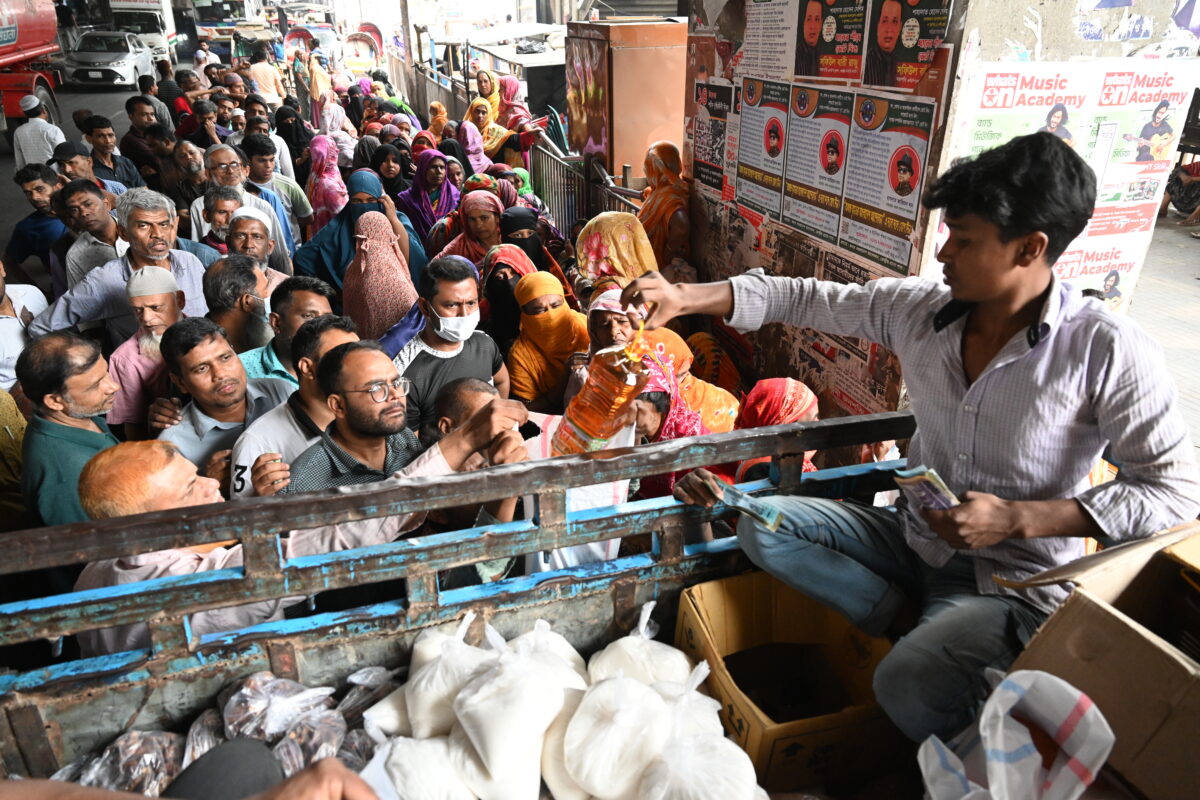
Bangladesh is receiving more remittances than at any point in its history, but the gains are not reaching household budgets. An explanation lies in how remittances are moved across borders. Much of the recorded increase comes from money moving into formal channels, while transfer fees and rising prices leave households with limited relief.
In the 2025 financial year, expatriate workers sent home US$30.3 billion — a 26.8 per cent increase from the previous year and the highest recorded annual inflow. Bangladesh’s remittance income reached more than US$34.5 billion through mid-June 2026 and is on course to exceed US$35 billion in the 2026 financial year. Yet inflation stood at 9.42 per cent in May 2026, its highest level in 16 months. Food prices also remain elevated despite record-high rice harvests. Nominal wages have consistently trailed inflation.
The surge in Bangladesh’s remittances is partly explained by its timing. The political crisis of August 2024, which saw former prime minister Sheikh Hasina resign and flee to India, disrupted the hundi networks — informal funds-transfer systems — that had long dominated cross-border money transfers. As politically connected brokers withdrew from the market, remittance flows that had previously bypassed the banking system shifted to formal channels.
But this does not amount to a rise in real earnings. Commentators have cautioned that the boom may represent a one-time jump rather than a sustained rise in migrant earnings or diaspora size. The question is whether the gains will hold as the political environment normalises.
Even where inflows do represent new earnings, spending pressures absorb much of the gains. Roughly two-thirds of Bangladeshi remittances go to consumption, while no more than one-third is directed towards investment, overwhelmingly in land and real estate rather than productive enterprise. As remittances raise demand for staples, intermediaries with significant price-setting power, not households, are able to reap the benefits of that extra demand. Remittance-financed consumption still raises living standards, but the effect is smaller than what headline numbers imply.
This is why Bangladesh has produced record-high rice harvests while rice prices have continued to rise. As The Financial Express observed in early 2026, powerful intermediaries can largely shape prices in Bangladesh’s rice market regardless of supply conditions. The Asian Development Bank identified stifled competition in wholesale markets as a primary driver of the country’s inflation.
A significant portion of remittance income never reaches families, lost to transfer fees and unfavourable exchange rate margins. A 2025 study found that sending US$100 to Bangladesh costs an average of US$9.4, nearly triple the cost three years earlier and more than anywhere else in South Asia. Sending the same amount to India or Pakistan costs between US$2.8 and US$5.1.
Some of this reflects exchange-rate volatility and macroeconomic instability, but much is due to weak competition among money transfer operators and opaque foreign-exchange pricing — factors that regulation can directly address. The government’s 2.5 per cent cash incentive for formal-channel remittances does not come close to compensating workers for what they lose by using them.
Bangladesh’s central bank has responded with orthodox monetary tightening, raising interest rates 11 times since May 2022 and keeping its benchmark policy rate at 10 per cent. But food inflation in Bangladesh is only weakly responsive to monetary policy because it is mainly driven by market structure rather than excess money. Tight monetary policy still matters for the exchange rate and non-food prices, but it does little to address the sources of food inflation.
The consequences of this dynamic are unequal and self-reinforcing. Remittance-receiving households gain real income. But because that income flows overwhelmingly into consumption rather than productive investment, it increases demand for the very commodities that inflation is putting out of reach for non-remittance households.
Since remittance flows are geographically concentrated, recipient households can outbid others for the same goods, pushing prices up for non-recipients as well. Bangladesh is projected to remain South Asia’s highest-inflation economy in 2026. At the same time, the country’s poverty rate has risen from 18.7 per cent in 2022 to around 21.4 per cent in 2025.
None of this is news to policymakers. Reform has stalled because each proposed measure shifts income away from well-organised groups that benefit from the existing system. Yet regulating foreign-exchange margins would return hundreds of millions of dollars annually to recipients at no public cost. Diaspora bonds, remittance-linked savings accounts and tax incentives that reward investment in enterprise have been shown to work in economies such as India and Israel, which have together raised more than US$35 billion through diaspora bonds.
Food markets are the most critical front. The Bangladesh Competition Commission needs enforcement capacity that matches the scale of the problem it faces. Unlike the regulation of foreign-exchange margins which is easier because of its low cost, competition enforcement in food markets is slower and harder — but it matters the most for households.
Bangladesh’s record remittances are a genuine achievement. Former chief advisor Muhammad Yunus’ administration deserves credit for restoring expatriate confidence and rebuilding foreign-exchange reserves. But stabilising the balance of payments is different from stabilising household budgets. Until transfer costs are regulated, investment incentives are restructured and competition in food markets is enforced, Bangladesh will continue to face the same problem — rising foreign earnings will fail to translate into food security or price stability.
Mezabahnur Masum is Co-Founder and Executive Editor at Dallas Barta.