
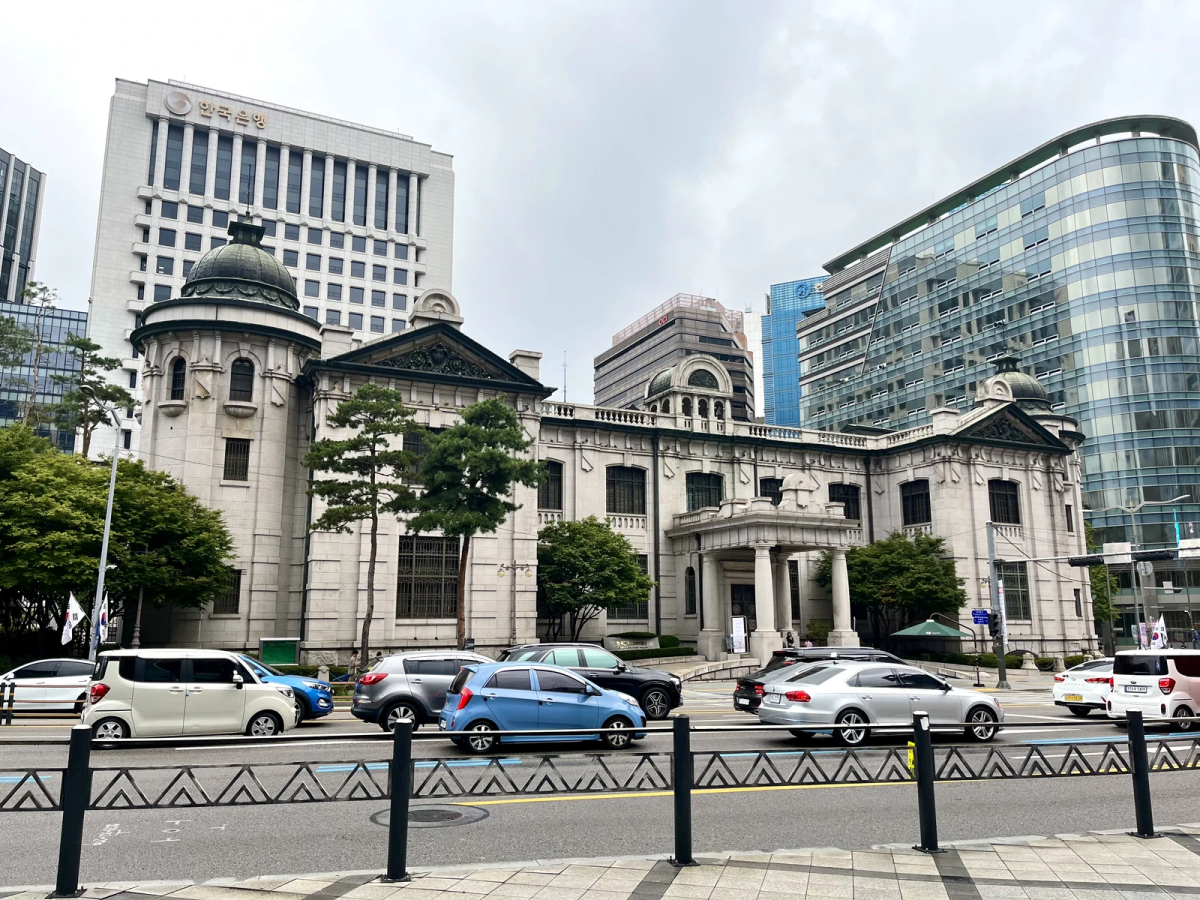
The won-dollar exchange rate has fallen to the mid-1,300 won range, and the Bank of Korea has assessed that if the currency stabilization trend continues, South Korea’s per capita gross national income (GNI) is highly likely to exceed $40,000 (approximately 54 million won) this year.
On September 9 in the Seoul foreign exchange market, the won-dollar exchange rate closed the previous session at 1,345.6 won, up 5.1 won. The average weekly closing rate fell from the upper 1,400 won range in the third week of July to the upper 1,300 won range in the third week of August, before extending its decline to the mid-1,300 won range in the first week of September.
The core driver of the exchange rate decline is dollar selling by export companies. Exporters have been flooding the market with dollars accumulated during the semiconductor boom, rapidly pushing the exchange rate lower. Large-scale order backlogs at shipbuilding and heavy industry companies added to dollar supply at the start of the month, while panic selling driven by fears of further declines amplified the drop.
During intraday trading on September 7, the exchange rate briefly fell to the 1,330 won range, marking its lowest level in one year and eleven months since October 4, 2024. However, the decline partially reversed as speculation spread that the National Pension Service had suspended its strategic currency hedging—which it had operated in response to won weakness—and moved to buy dollars. The NPS’s actions, combined with market sentiment seeking to confirm the exchange rate floor, provided momentum for a rebound.
The structural factor underpinning the exchange rate decline is the size of the current account surplus. This year’s current account surplus is projected to reach $450 billion (approximately 603 trillion won). The July current account balance came in at $42.08 billion (approximately 56.4 trillion won), exceeding $40 billion (approximately 53.6 trillion won) for a second consecutive month. The Bank of Korea estimates that if the current account balance averages around $43 billion (approximately 57.6 trillion won) over the next five months, the annual figure could surpass $450 billion.
The interest rate trajectory also supports won strength. With the Bank of Korea executing back-to-back rate hikes over two consecutive months, South Korea’s benchmark rate has risen to 3.00% per annum. In contrast, the U.S. benchmark rate stands at 3.50–3.75%, narrowing the upper-bound rate differential to 0.75 percentage points. The prevailing view is that the United States will maintain a hold, given that core inflation momentum remains subdued. As the rate differential narrows, the depreciation pressure on the won diminishes accordingly.
Yen strength is also working in the won’s favor. Key Bank of Japan officials have continued to make hawkish remarks, raising expectations for rate hikes, and the yen-dollar exchange rate has fallen to the 154 yen (approximately 1,300 won) range.
The Bank of Korea judges that if these trends persist, the likelihood of per capita GNI surpassing $40,000 this year is very high. Second-quarter nominal GNI rose 8.8% quarter-on-quarter, maintaining strong growth momentum. Nominal net factor income from abroad decreased from 13.7 trillion won to 12 trillion won, but nominal GDP growth offset the decline. Nominal GDP surged 26.4% year-on-year—the fastest pace in approximately 47 years since the third quarter of 1979—driven by improvements in the terms of trade led by rising semiconductor prices.
Market participants anticipate that, premised on the semiconductor boom persisting for the next one to two years and considering shareholder return policies at major semiconductor companies, a won-friendly environment will continue.
However, there are factors that could slow the pace of decline. Import settlement demand is a prime example. For importers that need to remit payments mid-month, current exchange rate levels may appear to be attractive buying opportunities. Onshore bargain-hunting demand could support the exchange rate floor.
Cha Young-hoo, an analyst at Eugene Investment & Securities, said, “The sharp correction may have largely run its course,” adding, “Domestic investor capital outflows represent a long-term trend spanning more than 15 years and will be a factor driving the exchange rate higher again once the semiconductor cycle ends. The exchange rate is expected to form a bottom between 1,250 and 1,300 won before resuming its long-term upward trend.”
The market’s next focus is the U.S. August Consumer Price Index (CPI), scheduled for release later this week. If the inflation data comes in above expectations, the Federal Reserve’s tightening vigilance could intensify, serving as a factor supporting the exchange rate floor. With New York markets closed overnight for the U.S. Labor Day holiday, supply-and-demand-driven trading is expected to continue for the time being.