
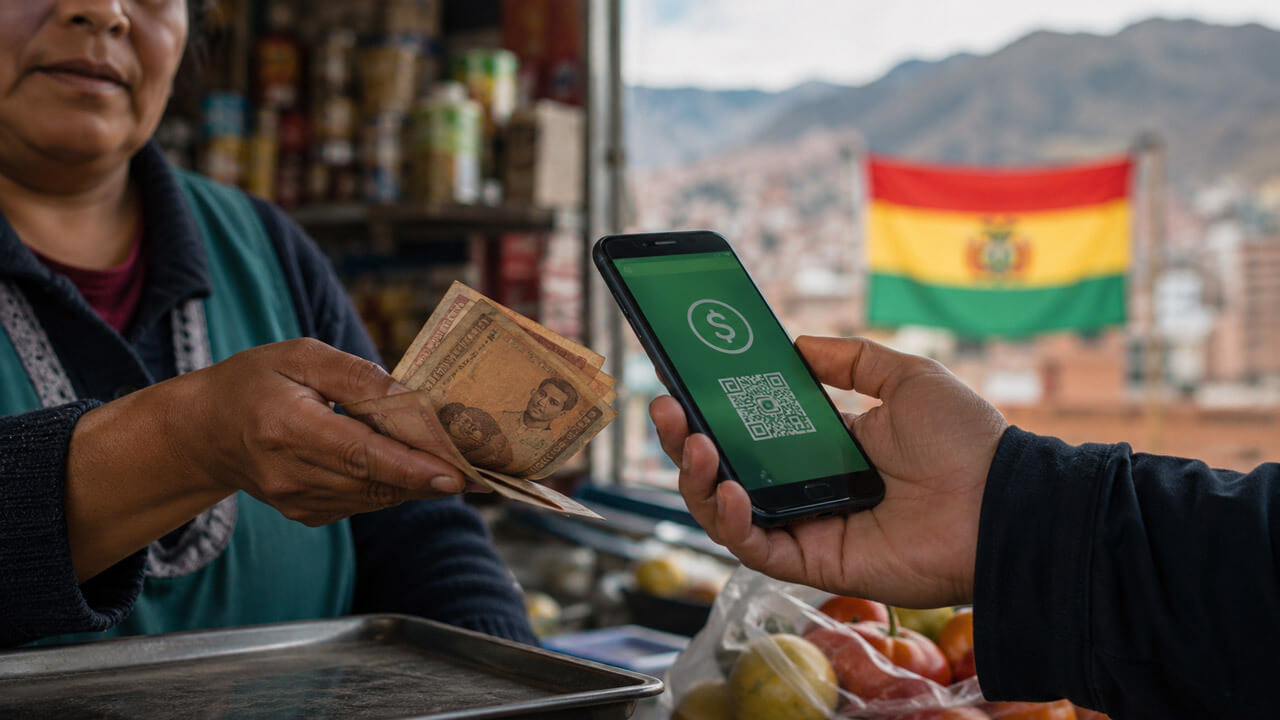
Bolivia’s government is evaluating whether to include USDT in its regulated payment system alongside the boliviano and the US dollar, according to local media.
Cryptoassets are authorized in the country with no legal-tender status attached.
The country’s finance minister described the current state as a prohibition lifted without a clear regulatory framework, with the technical review still underway, La Razon reported.
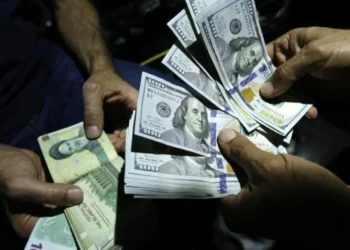
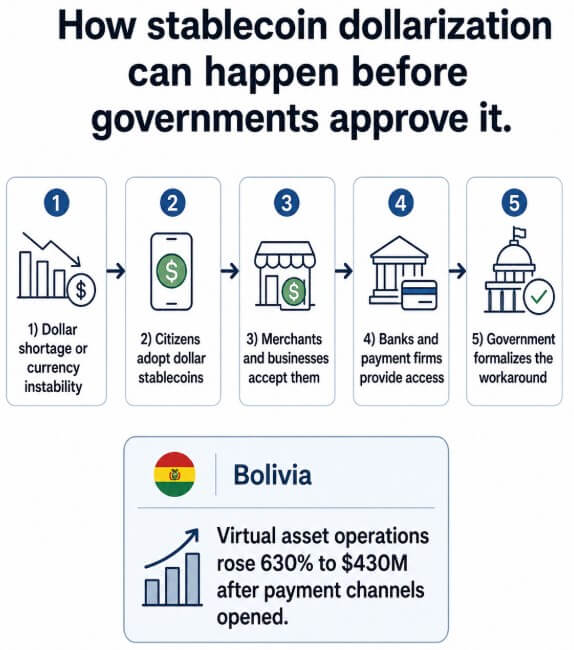
A dollar shortage or currency instability pushes citizens toward dollar-stablecoins first, with merchants and businesses accepting them next, banks eventually providing access, and governments formalizing the arrangement only once it has become too widely used to unwind.
Virtual asset operations in Bolivia rose over 630% in a year, reaching $430 million once electronic payment channels for virtual assets opened. First-half volume climbed from $46.5 million in 2024 to $294 million in the same period of 2025.
Why the same forces show up in other nations
The IMF found that naira depreciation, high inflation, and restricted foreign-exchange access pushed Nigerians toward dollar-stablecoins, using them as both a savings hedge and a way to pay overseas suppliers.
The fund said usage at that scale can resemble digital dollarization and weaken the transmission of domestic monetary policy.
Nigeria received about $59 billion in crypto-asset inflows between July 2023 and June 2024, accounting for roughly 60% of stablecoin inflows into sub-Saharan Africa since 2019.
When Nigerian regulators restricted banks’ access to crypto exchanges in 2021, the IMF found that activity moved to peer-to-peer channels, evidence that suppression can push activity into less visible corners of the market, with demand persisting regardless.
Stablecoin dollarization requires only a smartphone, a wallet, and sufficient merchant acceptance to make the token useful in day-to-day use.
The BIS describes this progression directly, saying that stablecoins can lower the barriers to holding dollar-denominated value and produce what the institution terms “stealth dollarization” in emerging markets.
That sequencing puts governments in a reactive position: citizens and merchants build the habit first, and official recognition follows only once the habit is already established, leaving the state to respond to a pattern its own citizens already set.
| Replication driver | Bolivia signal | Nigeria signal | Why it matters globally |
|---|---|---|---|
| Dollar shortage / currency pressure | Government evaluating USDT in payment system | Naira depreciation pushed users toward dollar-stablecoins | Stablecoins become a private workaround before policy catches up |
| FX access constraints | Cryptoasset channels reopened after restrictions lifted | Restricted FX access drove supplier-payment use | Stablecoins can become informal cross-border payment rails |
| Fast adoption after restrictions ease | Virtual asset operations rose 630% to $430M | $59B in crypto inflows from July 2023 to June 2024 | Demand can scale quickly once access exists |
| Regulatory suppression risk | Technical review still underway | 2021 restrictions pushed activity toward P2P channels | Bans may reduce visibility rather than eliminate use |
| Policy consequence | USDT could enter regulated payments without legal-tender status | IMF warns of digital dollarization risk | Governments may formalize behavior they did not initiate |
What breaks once the pattern scales
Monetary policy reaches fewer parts of the economy once savings and invoices are denominated in a currency that the central bank doesn’t issue.
The IMF makes this point about Nigeria, warning that widespread use of dollar-stablecoins can reduce demand for the local currency and weaken a central bank’s tools to influence economic behavior.
The BIS says interest-bearing stablecoins could compete directly with domestic-currency deposits in high-inflation economies. That deposit migration into stablecoins is already a live regulatory concern, since a bank can’t lend against dollars held in a private wallet the way it can against a deposit account.
Capital controls lose their grip once residents can move savings into dollar instruments from a phone.
The BIS says stablecoins can let residents bypass capital controls and foreign-exchange regulations, with smartphone-based transfers harder for authorities to monitor than conventional bank deposits.
Every country that integrates USDT also imports decisions it doesn’t control: Tether’s reserve policy, its banking relationships, its token-freezing decisions, the blockchains carrying the token, and its exposure to foreign legal action.
Tether’s first-quarter 2026 attestation put its token-related liabilities near $183.4 billion, backed in part by about $141 billion in direct and indirect US Treasury bill exposure, a scale that puts a single private issuer inside the kind of balance sheet decisions usually reserved for sovereign institutions.

Two ways the stablecoin pattern plays out
The US Treasury has described stablecoins as an internet-native dollar rail capable of reinforcing the dollar’s reserve-currency status, extending access to the dollar economy, and building fresh demand for US Treasuries.
The Richmond Fed makes a similar argument, saying reserve-backed stablecoins can strengthen global demand for safe dollar assets as adoption grows.
A run on a major stablecoin, a sanctions action against its issuer, opaque reserves, or a concentration of that issuer’s holdings offshore could turn the same rail extending dollar access into a source of financial instability for whoever depends on it.
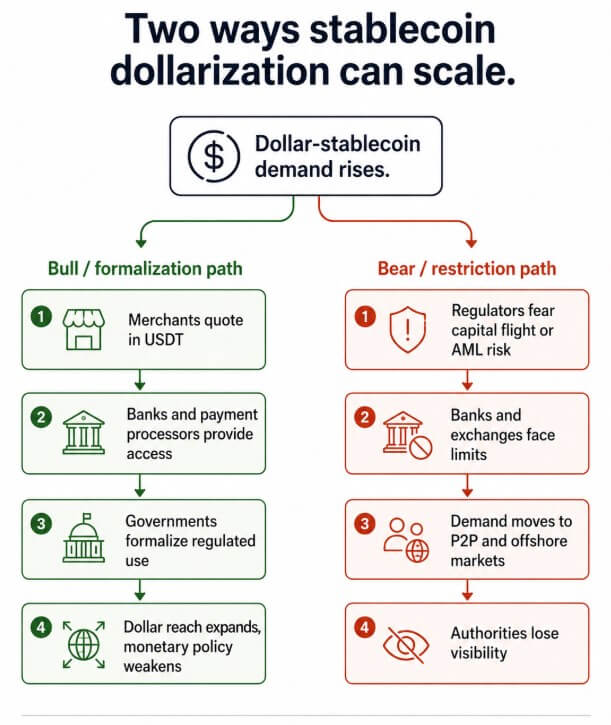
In the bull scenario, merchants and importers start quoting and settling invoices in USDT or other dollar-pegged stablecoin directly, and governments formalize that access through licensed banks and payment processors.
Monetary policy transmission weakens as more savings and invoices are denominated in dollars, and the dollar’s practical reach expands into economies that have never formally adopted it.
In the bear scenario, worries about money laundering, capital flight, or reserve strain prompt regulators to restrict banks’ and exchanges’ access to stablecoins.
Demand moves into peer-to-peer and offshore channels, and the country loses regulatory visibility into transactions that continue regardless.
The pattern becomes systemic once ten or twenty economies run the same sequence Bolivia is running now, alongside a handful of larger markets carrying Nigeria’s scale of strain.
Each wallet download that arrives before a government’s rule-making becomes its own small vote in that pattern, cast before any legislature takes one.