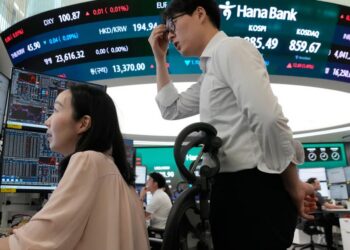

The US dollar traded near its lowest levels in almost two weeks on Monday as investors continued to scale back expectations for Federal Reserve interest rate hikes this year following weak US employment data. Meanwhile, the Japanese yen remained close to its weakest levels in four decades as markets monitored the possibility of official intervention in the foreign exchange market.
The euro held near $1.1435, close to a two-week high, while sterling traded at $1.3351. The US Dollar Index, which measures the greenback against a basket of six major currencies, was little changed at 100.9 in early trading.
Elsewhere, the Japanese yen traded at ¥162.32 per dollar, close to last week’s 1986 low of ¥162.84, after a sharp rally in the Japanese currency on Thursday fueled speculation about possible official intervention.
The euro also traded near a two-week high at $1.1416, while sterling stood at $1.3342 and the Dollar Index was at 101.08.
The South Korean won, meanwhile, weakened on the first day of round-the-clock domestic spot trading, falling to 1,531 won per dollar.
Yen remains in focus
The yen continued to be the main focus in currency markets as it hovered near 40-year lows. Expectations of potential Japanese government intervention kept traders cautious, although many analysts questioned whether intervention alone could reverse the broader trend.
Moh Siong Sim, currency strategist at OCBC Bank, said markets remain focused on the risks associated with the Federal Reserve’s hawkish policy stance, which continues to weigh on the yen. However, the possibility of Japanese intervention has limited further downside pressure on the currency.
“In the near term, I expect the yen to remain under pressure,” he said.
Sim added that investors increasingly fear Japanese authorities may have abandoned their traditional strategy of signaling intervention in advance and instead adopted a more targeted approach aimed at squeezing speculators and raising the cost of betting against the yen.
Ben Bennett, Head of Asia Investment Strategy at L&G Asset Management, said he expects Japanese authorities to intervene if currency volatility rises further. However, he emphasized that broader exchange rate trends are driven primarily by fundamental factors, including Japan’s expansionary fiscal policy and the wide interest rate differential with the United States.
“I don’t think intervention will change that trend,” Bennett said.
Dollar catches its breath
The US dollar struggled to recover after posting its worst weekly performance since April, following data showing a sharp slowdown in US job growth during June, prompting investors to reduce expectations for further rate hikes.
Market attention is now turning to the minutes of the Federal Reserve’s June meeting, due on Wednesday, for additional clues about policymakers’ views on the future path of interest rates.
Investors are also awaiting US inflation data scheduled for release next week, which is widely seen as the next major catalyst for monetary policy expectations.
Analysts at Commonwealth Bank of Australia said the meeting minutes could be shorter and less detailed than usual, reflecting Federal Reserve Chairman Kevin Warsh’s view that the central bank has historically provided too much forward guidance to markets.
Sim expects the US dollar to appreciate by around 2% to 3% by the end of the year but believes the currency may remain range-bound in the near term as some investors return to carry trade strategies that benefit from interest rate differentials.
“I expect the dollar to trade sideways in the near term,” he said.