
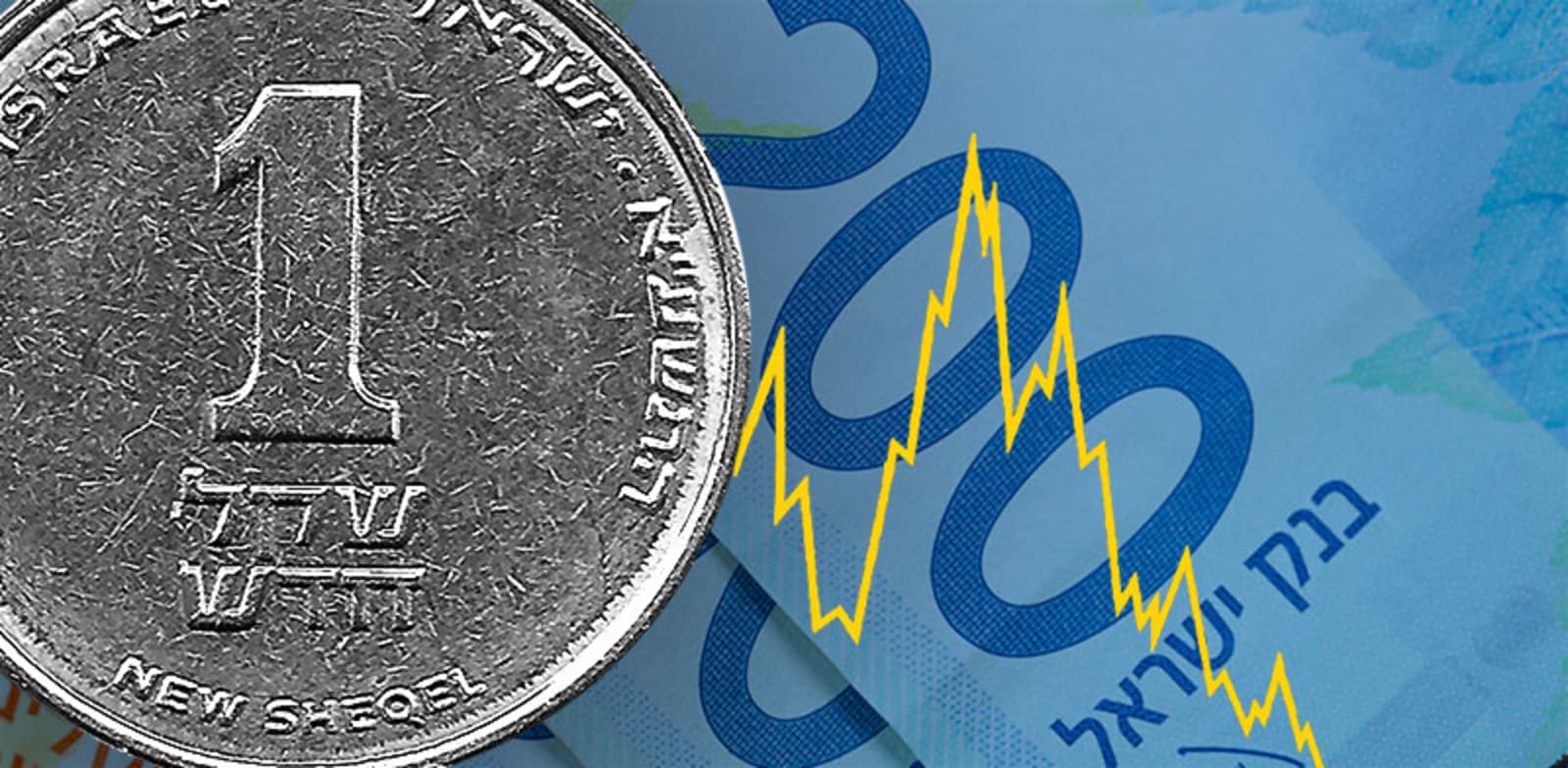
After just 30 days, the shekel’s impressive run came to a sudden halt. In May, it was traded at NIS 2.8/$, but the exchange rate has now reached NIS 3/$, making the shekel one of the world’s weakest currencies in the past month. In fact, among the developed markets, only the Russian ruble and the Norwegian krone, both victims of the slide in the price of oil, have performed worse.
Bank Hapoalim chief markets strategist Modi Shafrir finds several factors responsible for the shekel’s sudden change of direction: the strengthening of the US dollar globally; the rise in Israel’s risk premium since the agreement between the US and Iran; intervention by the Bank of Israel in the foreign exchange market; the falls on Nasdaq; and interest rate gaps between Israel and the US. Meanwhile, the trend in the exposure of Israeli financial institutions to foreign currency has reversed after eighteen months, which could accelerate the shekel’s depreciation.
1.The risk premium
One of the ways of measuring the risk premium is to compare the return on Israeli government bonds with those of the US. The spread between them represents the premium that the market expects to receive for investing n Israel. Another way is based on CDS (credit default swap) contracts issued by financial institutions as a kind of insurance for bondholders against insolvency by the debtor. The investor pays a periodic premium, and in return, if Israel becomes insolvent, the institution issuing the CDS pays the bondholder the interest and capital, in accordance with the contract terms.
The price of a CDS is quoted in basis points. In November 2022, before the announcement of the government’s judicial overhaul program, Israel’s risk premium was at a little under 40 basis points, meaning that the cost of insurance at that time was about 0.4% of the amount insured. At the height of the program, it was 60-65 basis points, and when war broke out in October 2023 it jumped to 140-180 basis points.
Afte the ceasefire agreement it fell dramatically, to 49 basis points, but since then it has climbed steadily to 54 basis points today.
The risk premium reflects investors’ perception of the risk of investing in Israel, including the geopolitical risk. The performance of the Tel Aviv Stock Exchange and that of the shekel move partly in tandem with the risk premium, but each is also affected by many other factors. At present, both the stock market and the shekel are weak, and the geopolitical situation coincides with prices on the Israeli capital market that investors see as too high.
RELATED ARTICLES
2. Interest rate gaps
According to Shafrir, interest rate gaps between Israel and the US are also causing the shekel to be weak. While the Israeli market is pricing in an interest rate of 2.9% in a year’s time, in the US the markets are still pricing a rise in interest rates, even though inflation expectations have moderated because of the fall in the price of oil.
Even more important than interest rate projections is the real interest rate, i.e., net of inflation.
3. Intervention by the Bank of Israel
In May, the Bank of Israel bought $800 million to ensure the proper functioning of the foreign exchange market, and the assessment on the market is that it continued to intervene in the market in June. The remarks of Governor of the Bank of Israel Amir Yaron at the Eli Hurvitz Conference on Economy and Society earlier this month signaled to the markets more than the known intervention by the central bank. “To the extent that inflation falls and nears the lower limit [of the target range], that will justify more expansionary monetary policy at a more rapid rate,” he said. In other words, if inflation expectations approach 1% as a result of the appreciation of the shekel, the bank will cut interest rates faster.
4. Overseas stock markets and Israeli financial institutions
Technology stocks have recently dragged indices on US markets downwards in a way that has a direct impact on the shekel. “The financial institutions in Israel set their currency exposure level. If stocks in the US rise, they have to sell dollars in order to maintain the exposure level that they planned,” explains Jonathan Katz, chief economist at Leader Capital Markets.
Katz says that in addition to this principle, which directly connects the shekel-dollar exchange rate to the performance of US stock markets, he has discerned an additional, new trend. He processed Bank of Israel data and found that in April (when the provisional ceasefire with Iran was signed, on the eighth of the month), the financial institutions raised their currency exposure from 19.1% to 20.5%. This too is an indication of the assessment of the risk of investment in Israel, and represents a change of trend.
The currency exposure level began to rise during 2023 because of the judicial overhaul program, and it rose from 19% on the eve of the war to 23% in September 2025. Since then it has consistently fallen. “The institutions registered the improvement in geopolitical risk,” says Katz, “but these are April figures and we are now in June. In March-April the shekel performed strongly, and it was a positive period on world markets. I can only suppose that since then they have not changed position with the fragile ceasefire and the continued fighting in the north, while the agreement with Iran has been interpreted as perhaps not benefitting Israel.”
Katz adds that if the institutions have continued to raise their currency exposure, “that is a factor that to a certain degree works in favor of depreciation.” He stresses however that the exchange rate is affected by a range of factors. “The institutions are one factor and a very significant one, but still only one among many. The institutions have an impact in two ways: in their response to the direction of stocks overseas, and in their perception of risk in Israel as reflected in their currency exposure. The element of reduction of exposure is probably not with us at this stage, and so we will be much more affected by the direction of the US stock market.”
What will happen next?
First of all, the analysts remind us that the shekel-dollar exchange rate is still at a historically low level, such as has not been seen for thirty years. The Bank of America recently recommended its customers to go long on the US dollar against the shekel and the Hungarian forint. The bank cites the structural factors that move the shekel and its almost complete dependence on the performance of the S&P 500 Index, which the bank expects will fall by 5% over the coming year.
The Bank of America sees the shekel-dollar rate reaching NIS 3.14/$ within three months, but recommends exiting the position if the rate falls to NIS 2.9/$.
Nevertheless, it should be stressed that the foreign exchange market is deep and complex and affected by many factors, and is almost impossible to predict. For example, just before the bombing campaign against Iran began in March, after which the shekel appreciated rapidly, investment bank Goldman Sachs recommended selling shekels and buying dollars.
Shafrir says that factors tending towards weakness of the shekel against the dollar exist, but that there are also basic forces working in favor of a strong shekel in the long term, among them a surplus of exports over imports and substantial investment in Israel’s technology industry. “The shekel is still strong, and although it has weakened, the Bank of Israel is expected to cut its interest rate. “We, and the market, are pricing a 100% probability of an interest rate cut in July, but it is unlikely to be an aggressive one,” Shafrir says. He adds that after the CPI reading for May, which was surprisingly low, there was talk of a 0.5% interest rate cut, “but the weakening of the shekel is not supportive of that.”
“In the past eighteen months, the strong shekel is what has restrained inflation, but looking six months or more ahead, if it remains at these levels or weakens, the picture will be a little more inflationary. But that is a long-term process,” is how Shafrir sums up the situation.
Published by Globes, Israel business news – en.globes.co.il – on June 29, 2026.
© Copyright of Globes Publisher Itonut (1983) Ltd., 2026.