
Kathmandu. Further evidence has been found to confirm suspicions of tax evasion and foreign exchange misappropriation through offshore transactions in the procurement of electronic passports (e-passports).
The ownership structure of the Singapore-based company used for commission payments for the e-passport contract awarded to the French security technology company IDEMIA has further strengthened this evidence.
There are mainly three companies involved in the passport contract operation – IDEMIA, Capital Biz Solution, and Delta Core Pvt. Ltd. Among these, IDEMIA is a company headquartered in France, which has received the contract for passport printing.
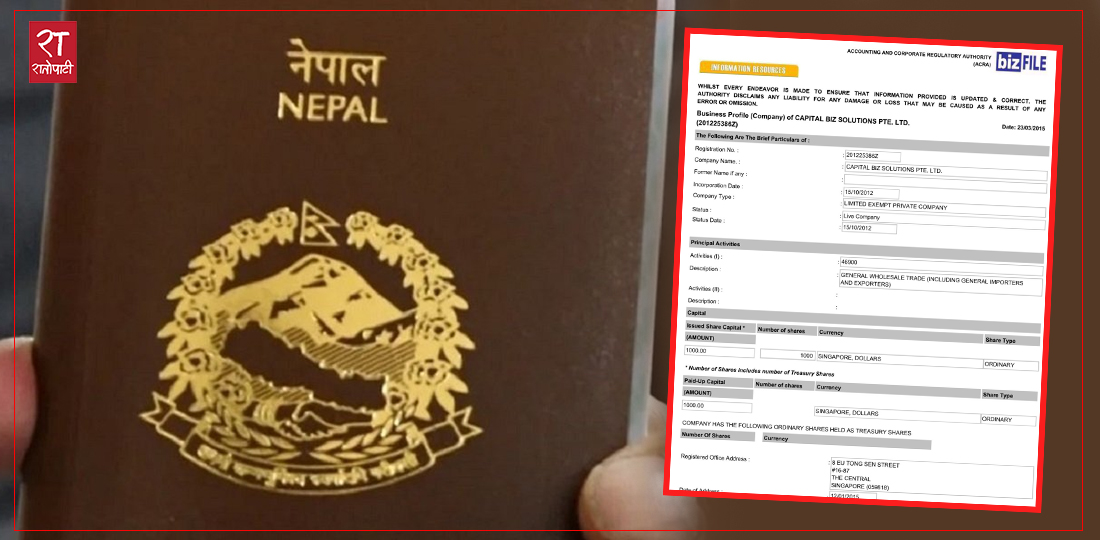
On the other hand, a company named Capital Biz Solution is registered in Singapore. It is shown as an official agent of IDEMIA. However, this company is not registered in Nepal.
On the other hand, Delta Core Private Limited is a company registered with the Office of the Company Registrar in Nepal. It has been working as a subcontractor for IDEMIA, claiming to provide ‘maintenance and technical support’ for the e-passport project.
However, surprisingly, the directors of Capital Biz Solution, registered in Singapore, and Delta Core Pvt. Ltd., registered in Nepal, are the same. According to the details from Singapore’s regulatory authority, the Accounting and Corporate Regulatory Authority (ACRA), five Nepali citizens have invested in the company. These include Siddharth Pandey, Bipin Basi, Sharad Gurung, Arjun Gurung, and Vijayraj Pant. It appears that all five of them hold an equal 20/20 percent share ownership in this company.
_wvzXabpOKv.jpg)
Documents obtained from the Office of the Company Registrar also show equal investment from these same five shareholders in Nepal’s Delta Core Pvt. Ltd. Sources claim that the objective of making a foreign company with 100% Nepali directors an agent for a Nepali contract is precisely to evade tax and misappropriate foreign currency.
Furthermore, sources indicate that the company transfers funds accumulated in Singapore to other locations through another suspicious entity based in Hong Kong.
Unusual Commission: 12 Percent for Facilitating the Contract
Generally, in international contracts, agents receive only 2 to 5 percent commission. This payment to the agent is made based on the awarded contract and payments made. This practice, prevalent internationally, is considered normal and indispensable.
This agency arrangement is practiced because not all companies can have direct access to the markets of all countries. Since there is no need for investment and almost all the amount remains as profit, the commission is comparatively low.

However, even the commission given to the agent appears to be highly unusual. A transaction order has been found showing that IDEMIA paid a 12.25 percent commission to the broker for 2.5 million MRP booklets supplied to the Department of Passports under the Ministry of Foreign Affairs.
Generally, any commission received from a government project is officially declared in Nepal. Operating such funds through foreign bank accounts without doing so is considered a serious crime. However, sources claim that in this contract, Delta Core shows very low income for its subcontract work, and even this amount is sent out in the name of commission.
This company has allegedly sent substantial commissions not only from Nepal’s passport project but also from the embossed number plate project for vehicles, collected from consumers for each number plate, through Capital Biz Solution to Singapore.

Plan to Move to Dubai After Investigation Appears Likely
Recently, complaints regarding this suspicious triangular relationship and financial crime have reached various regulatory bodies. Amidst this, the intermediary group has started devising new schemes to evade investigation.
According to information received, they have currently initiated the process of registering a new company in Dubai. Experts say that doing so could further complicate potential investigations and cross-border financial monitoring processes.
“The more countries a network expands into for offshore transactions, the more difficult the investigation process becomes. It becomes even more difficult as tax haven countries show less interest,” the expert says, adding, “Coordination with a third country makes such investigations even more complex.”
_DcGvBi7LIF.jpg)
Possibility of the Biggest Financial Crime to Date
Operating commission amounts received from government projects through foreign bank accounts without official declaration in Nepal is a serious crime. Experts state that this attracts offenses under the Income Tax Act for tax evasion, the Foreign Exchange (Regulation) Act for illegal foreign currency transactions, and the Prevention of Money Laundering Act.
“If these allegations and the fact of the 12.25 percent commission are legally confirmed, this could become one of the biggest cases of tax evasion, money laundering, and foreign exchange misuse through offshore transactions in the name of commission,” says an expert on taxation. “The main question is whether the income generated in Nepal was intentionally moved abroad through foreign structures to avoid tax liability, and it is the government’s responsibility to investigate this in detail.”