

In the early Asian trading session on Friday (May 1, Beijing time), spot gold was trading near $4,630 per ounce. Gold prices rose nearly 2% on Thursday, driven by a weaker US dollar and a pullback in oil prices, but still recorded a second consecutive monthly decline due to inflation concerns triggered by the situation in Iran. US crude oil traded near $105.75 per barrel, with oil prices falling nearly 3% on Thursday as hedge funds locked in profits at the end of the month, though tensions in Iran continued to support oil prices.

Key Focus for the Day

Stock Market
US stocks closed higher on Thursday, with the S&P 500 Index and Nasdaq Composite recording their largest monthly gains since November 2020 and April 2020, respectively. The Dow Jones Industrial Average also posted its best monthly performance since November 2024. Investors temporarily overlooked the oil supply shock caused by geopolitical tensions, supported by a series of strong corporate earnings reports and economic data.
On the day, the Dow Jones Industrial Average rose 1.62%, the S&P 500 Index climbed 1.02%, and the Nasdaq Composite increased by 0.89%. Industrial stocks led the gains, driven by Caterpillar, while tech stocks were weighed down by capital expenditure concerns surrounding Meta and Microsoft.
 Alphabet surged 10.0% following record growth in its cloud business, while Amazon rose 0.8%. Meta and Microsoft fell 8.7% and 3.9%, respectively. Caterpillar’s shares soared 9.9% to hit a record high, driven by strong demand for power generation and construction equipment. Eli Lilly and Co. raised its profit outlook due to robust demand for weight-loss drugs, pushing its shares up 9.8%.
Economic data showed that the US economy grew 2.0% in the first quarter, with initial jobless claims dropping to their lowest level since 1969. However, energy prices kept inflation above 3%, weakening market expectations for a near-term interest rate cut by the Federal Reserve. In the most divided vote since 1992, the Fed kept rates unchanged, acknowledging uncertainties stemming from conflicts in the Middle East. Despite ongoing tensions between Iran and the US, a pullback in oil prices and solid economic growth helped markets finish strongly.
Gold Market
Gold prices rose more than 1.7% to $4,618.67 per ounce on Thursday, supported by a weaker US dollar and a retreat in oil prices. However, due to inflation concerns fueled by the situation in Iran, gold prices recorded a second consecutive monthly decline. US gold futures settled 1.5% higher at $4,629.60 per ounce. The softer dollar benefited from Japan’s first currency market intervention in nearly two years to support the yen, while global oil prices retreated after hitting four-year highs, easing inflationary pressures from surging energy costs.

The Federal Reserve maintained interest rates and expressed concerns about inflation, while the Bank of England also kept rates steady and warned of potential sharp rate hikes amid fears of an Iran war. The March PCE price index increase matched expectations.
Citi believes that short-term selling pressure on gold may remain significant but remains optimistic in the medium term, maintaining a three-month target price of $4,300 and a six-to-twelve-month target price of $5,000. Additionally, the share of gold in India’s central bank foreign exchange reserves rose to 16.7%. Spot silver, platinum, and palladium also gained approximately 3%, 5.3%, and 4.9%, respectively.
Oil market
Oil prices fell on Thursday after touching a four-year high above $126 per barrel earlier in the session, primarily due to concerns that a US-Iran conflict could lead to prolonged supply disruptions in the Middle East. Brent crude futures (near-month contract) dropped 3.41% to settle at $114.01 per barrel, having earlier reached $126.41, the highest since March 2022. The more actively traded July contract, however, rose $0.44 to close at $110.88. US crude futures fell 1.69% to settle at $105.07, after peaking at $110.93 during the session. Despite the decline, both benchmark crude contracts posted their fourth consecutive monthly gain, reflecting concerns that an Iran conflict might disrupt global oil supplies over the long term.

The retreat in oil prices from their highs lacked a clear trigger, with analysts attributing it to two large sell orders targeting the June Brent contract, volatility ahead of contract expiration, and hedge funds locking in profits at month-end.
Meanwhile, a U.S. official revealed that President Trump will be briefed on new military strikes against Iran to push for negotiations; Iran has warned that it will respond with a “long and painful” retaliation if the U.S. launches another attack, and reiterated its control over the Strait of Hormuz, making the prospect of reopening the waterway bleak.
Foreign exchange market
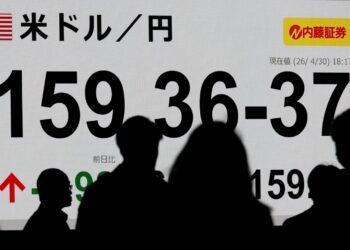
The U.S. dollar plummeted on Thursday, primarily due to Japanese authorities intervening to support the yen. The dollar-yen exchange rate fell by 3% to 155.5 yen at one point, marking the largest single-day drop since late December 2024. Japan’s Finance Minister Satsuki Katayama had previously issued the strongest signal yet for intervention, stating that the timing for taking “decisive” action was approaching. Two informed sources disclosed that Japanese officials had purchased yen after it fell to its lowest level since July 2024. As a result, the U.S. Dollar Index dropped by 0.80% to 98.06, ending two consecutive days of gains.

Meanwhile, the European Central Bank kept interest rates unchanged as expected but held extensive discussions on raising rates to address inflation spiking to 3%. The Bank of England also maintained interest rates and explored potential economic impact scenarios stemming from an Iran war.
Regarding risks of war in the Middle East, the U.S. attempted to break the deadlock by imposing a maritime blockade on Iran’s oil exports. President Trump received a briefing on plans for a new round of military strikes.
The Federal Reserve kept interest rates unchanged this week, but divisions emerged internally, with one policymaker advocating for a rate cut and three others arguing that the policy statement should no longer convey a dovish bias. In other currency movements, the euro rose by 0.51% to $1.1733, the pound increased by 0.98% to $1.36075, and the dollar fell by 1.28% to 0.78110 Swiss francs.
International News
Trump stated that only a few individuals are aware of the actual progress in the U.S.-Iran negotiations.
U.S. President Trump stated on April 30 that, aside from himself and a few others, no one is aware of the current actual progress in the negotiations between the U.S. and Iran. (Xinhua News Agency)
S&P is considering shortening the observation period for index inclusion from 12 months to 6 months.
S&P Dow Jones Indices announced that it is seeking market participants’ feedback on a proposal to shorten the inclusion observation period for candidate companies in the S&P Composite 1500 Index from 12 months to 6 months. The proposed adjustment only affects the inclusion eligibility criteria for the S&P 500 Index, S&P MidCap 400 Index, and S&P SmallCap 600 Index, and will not automatically lead to the inclusion of mega-cap companies in the S&P 500 Index.
The UAE bans its citizens from traveling to Iran, Lebanon, and Iraq.
On the evening of April 30, the UAE Ministry of Foreign Affairs announced that, given developments in the regional situation, it was prohibiting its citizens from traveling to Iran, Lebanon, and Iraq. In a statement, the UAE Foreign Ministry urged all Emirati citizens currently in those countries to leave as soon as possible and return to the UAE within the shortest timeframe to ensure their safety. The ministry stated it would continue monitoring the status of its citizens abroad and guaranteeing their security, emphasizing the importance of adhering to relevant instructions and advisories during such circumstances. Additionally, the UAE Ministry of Foreign Affairs encouraged its citizens in Iran, Lebanon, and Iraq to contact diplomatic departments through designated emergency communication channels, describing this as one of the precautionary measures taken by the country to safeguard citizens’ safety. (Xinhua)
U.S. Media: Trump Administration Seeks to Form New International Coalition for the Strait of Hormuz
According to a report by The Wall Street Journal on April 30, the Trump administration is pushing to establish a new international coalition to restore shipping flow through the Strait of Hormuz. The report said that on April 29, the U.S. Department of State sent an internal cable to embassies proposing an initiative named the “Maritime Security Framework,” urging U.S. diplomats to encourage host governments to join. According to the cable, the coalition, led jointly by the U.S. Department of State and the U.S. Central Command, will share intelligence, coordinate diplomatic actions, and enforce sanctions. The State Department will serve as the command center for diplomatic efforts, while the Central Command will provide “real-time maritime situational awareness” to commercial vessels and coordinate intelligence sharing among partner militaries. Although the “Maritime Security Framework” is not a military alliance, the cable still instructed U.S. officials to ask their foreign counterparts whether they are willing to join as “diplomatic partners and/or military partners.” Furthermore, this coalition will complement other maritime security task forces. The U.S. hopes other nations will participate in managing current and future operations in the Strait of Hormuz. (Xinhua)
Trump claims to have ‘destroyed’ Iran’s nuclear capabilities.
On April 30 local time, U.S. President Trump stated at a White House press conference that recent U.S. military actions had “destroyed” Iran’s nuclear capabilities and significantly weakened its overall military strength. He claimed that Iran’s navy and air force were “almost non-existent,” approximately 82% of drone factories had been affected, nearly 90% of missile factories were damaged, and most missile systems had been destroyed. Trump noted that the U.S. had completed key strike missions in a short period and emphasized that if no action had been taken, Iran “might acquire nuclear weapons,” which he described as something “absolutely unacceptable.” Trump said that current negotiations with Iran had stalled but added that Iran was “very eager to reach an agreement.” He mentioned that the details of the negotiation were known only to a small number of high-level U.S. officials. Trump stated that Iran had suffered severe blows in recent conflicts, with its “leadership and military almost destroyed” and its naval vessels “almost completely sunk.” He remarked that this situation complicated negotiations because “it was even difficult to determine who was in charge.” Trump added that under economic sanctions and military pressure, Iran’s economy was facing serious difficulties, with a significant drop in oil revenue. He stressed that the U.S. objective was to force Iran to abandon its nuclear weapons development while pushing for a swift resolution through negotiations. When asked whether Iran’s team would participate in the 2026 World Cup, Trump responded that he “did not oppose it,” stating that such decisions could be made by FIFA, “let them compete.” As of now, Iran has not responded to these statements. (CCTV News)
Dissatisfied with European Allies, Trump Hints at Considering Troop Reductions in Spain and Italy
On April 30 local time, U.S. President Trump expressed during a White House press conference that some European allies had “not provided assistance” on the Iran issue, specifically naming Spain and Italy for their “poor performance.” He stated that the U.S. did not “rely on other countries” when handling situations in the Middle East and mentioned that previous tests of allied intentions showed that most countries chose “non-involvement.” Trump noted that the U.S. had achieved “full control” over the Iran issue, asserting that military operations could be completed without external support, reiterating that Iran “must not possess nuclear weapons.” He stated that U.S. military actions had severely impacted Iran, weakening its military strength. Additionally, Trump criticized certain European countries’ stances on the Ukraine issue and questioned Germany’s current policies, suggesting challenges in areas like immigration, energy, and regional security. When asked whether adjustments to troop deployments in Europe, similar to those affecting Germany, might occur, Trump responded that it was “quite likely,” hinting at possible troop withdrawals from Spain and Italy. (CCTV News)
U.S.-Venezuela Resume Direct Civil Aviation Flights After Seven-Year Suspension
On the morning of April 30 local time, a flight operated by American Airlines departed from Miami, Florida, en route to Caracas, the capital of Venezuela. This marked the first direct flight between the two nations after a seven-year suspension. Due to continuous U.S. interference in Venezuela’s internal affairs, Venezuela severed diplomatic relations with the U.S. in January 2019. On January 3 this year, the U.S. launched a large-scale military strike against Venezuela, forcibly detaining President Maduro and his wife and bringing them to the United States. On March 5, the governments of the U.S. and Venezuela announced their agreement to restore diplomatic and consular relations. (Xinhua News Agency)
Trump’s 60-Day War Authority Set to Expire on May 1
Since the U.S. government formally notified Congress on March 2 of initiating military strikes against Iran, the timeline reaching May 1 marks exactly 60 days. According to the War Powers Act passed by Congress in 1973, the U.S. President is limited to deploying troops for 60 days without Congressional approval. If the President provides a written justification to Congress regarding the necessity of continued troop deployment, a 30-day extension can be granted, though this period is solely intended for safe troop withdrawal and cannot involve further offensive military actions. On the 29th, U.S. Secretary of Defense Hegseth faced congressional questioning. This marked his first testimony before Congress since the end of February, when the U.S. and Israel initiated military actions against Iran. During discussions about the U.S. strikes on Iranian nuclear facilities, Hegseth’s inconsistent statements drew skepticism from Democratic lawmakers. On the 29th, U.S. Department of Defense officials stated that expenditures related to the conflict with Iran were estimated to have reached $25 billion so far. Adam Smith, the senior Democratic member of the House Armed Services Committee, remarked that Hegseth needed to clarify the objectives of Trump’s administration in launching this war, noting that “we have seen the costs, and they are extremely high.” (CCTV)
OPEC+ Representatives Predict Likely Symbolic Production Increase in June
Three OPEC+ representatives revealed that following the unexpected exit of the UAE from OPEC+, the organization is likely to agree on another symbolic production increase in June. Two representatives stated that the seven major oil-producing countries led by Saudi Arabia and Russia are expected to raise production quotas by 188,000 barrels per day during a video conference scheduled for Sunday. However, due to blockages in the Strait of Hormuz, this production increase may not be practically implemented. According to Interfax, Russian Deputy Prime Minister Alexander Novak stated that the UAE’s withdrawal from OPEC would not immediately trigger a price war, as the conflict with Iran constrained oil-producing nations’ ability to release supplies.
The Trump Administration’s Investigation into Powell Has Concluded; the U.S. Department of Justice Prepares to Appeal the Subpoena Ruling Against the Federal Reserve
The U.S. Department of Justice plans to appeal a federal judge’s ruling that had blocked prosecutors from using a grand jury subpoena during an investigation into cost overruns at the Federal Reserve. U.S. Attorney Jeanine Pirro stated that the appeal is necessary because allowing the ruling to stand would undermine a key investigative tool for prosecutors. Although the investigation into the Federal Reserve and Chairman Powell has been closed, the Department of Justice will still seek an appeal. Senator Thom Tillis indicated that the appeal aims to challenge the legal basis of the ruling rather than reopen the investigation.
Iran claims that 40% of its trade can be shifted to land transportation.
The chairman of the Container Committee of the Iran Shipping Association stated on April 30 that despite the adversary’s attempts to cut off Iran’s maritime routes through a naval blockade, Iran is well-prepared for such situations due to previous similar experiences. He noted that 40% of Iran’s trade could be redirected to land transportation. For instance, up to 15% of the country’s transit freight volume can be diverted to the International North-South Transport Corridor (INSTC). The INSTC is a transport route connecting countries such as Russia, Central Asia, Iran, and India. (CCTV News)
Iranian President: Iran Has Completely Lost Trust in the United States
According to reports by Iranian media on April 30, Iranian President Pezeshkian stated during a phone call with Belarusian President Lukashenko that Iran has completely lost trust in the United States. During the call, Pezeshkian said that resolving differences through dialogue and diplomatic efforts has always been the priority. However, during previous negotiations, the United States and Israel launched two attacks on Iran, and similar actions could happen again, which has led Iran to completely lose trust in the United States. (Xinhua News Agency)
Japanese Government and Central Bank Implement Forex Intervention
According to a report from Japan on April 30, unnamed government officials stated that after the yen exchange rate fell below the 160-yen-per-dollar mark, the Japanese government and the Bank of Japan implemented forex intervention measures, buying yen and selling dollars to stabilize the currency. Japanese sources noted that due to high oil prices and diminished expectations of interest rate cuts by the Federal Reserve, the yen exchange rate once dropped below 160 yen per dollar, marking a new low since July 2024. Japanese officials immediately issued strong warnings against speculative activities in the market. In July 2024, the yen exchange rate briefly fell below 161.9 yen per dollar, prompting the Japanese government and central bank to take forex intervention measures. (CCTV News)
Israeli Defense Minister stated that Israel might ‘soon’ take further action against Iran.
According to Israeli media reports on the 30th, Israeli Defense Minister Katz stated on the same day that although Israel supports the diplomatic efforts between the United States and Iran, Israel may ‘soon need to take further action’ to ensure the elimination of the ‘existential threat’ posed by Iran. (Xinhua News Agency)
Domestic Highlights
Chinese scientists have unraveled the key physical ‘black box’ limiting the efficiency of perovskite solar cells.
For the first time, a Chinese research team has uncovered the key physical ‘black box’ that constrains the efficiency of formal-structure perovskite solar cells. They innovatively proposed a design for continuously gradient-doped electron transport layers. Based on this strategy, the solar cell devices achieved a steady-state photoelectric conversion efficiency of 27.17% and a reverse scan efficiency of 27.50%, as certified by an international authoritative institution, setting a new record for the highest photoelectric conversion efficiency of formal-structure perovskite photovoltaic devices. This research was conducted by the team led by Professor Yuan Mingjian and specially appointed researcher Jiang Yuanzhi from the College of Chemistry at Nankai University, in collaboration with the team led by researcher Xu Jian from Beijing Institute of Technology. The related findings were published online in the international academic journal Nature on April 30th, Beijing time. (Xinhua News Agency)
China Accelerates Quantum Computing Development as Capital Flows into Quantum Technology
As a key area driving a new wave of technological revolution and industrial transformation, quantum technology encompasses several fields, including quantum computing, quantum communication, and quantum measurement. Among these, quantum computing, which leverages quantum techniques to achieve enhanced computational power, is considered the most disruptive and challenging direction. Reporters learned that currently, domestic efforts in quantum computing hardware, software, and cloud services are accelerating with coordinated research aimed at enabling quantum computing to address practical problems as soon as possible. This year, several domestic companies in the quantum technology sector have announced substantial funding rounds, with nearly 10 instances of single-round financing exceeding 100 million yuan. At present, capital is rapidly flowing into the quantum technology sector. Market analysts estimate that in the first quarter of this year, total financing related to domestic quantum technology surpassed the annual total for 2025. (CCTV Finance)